
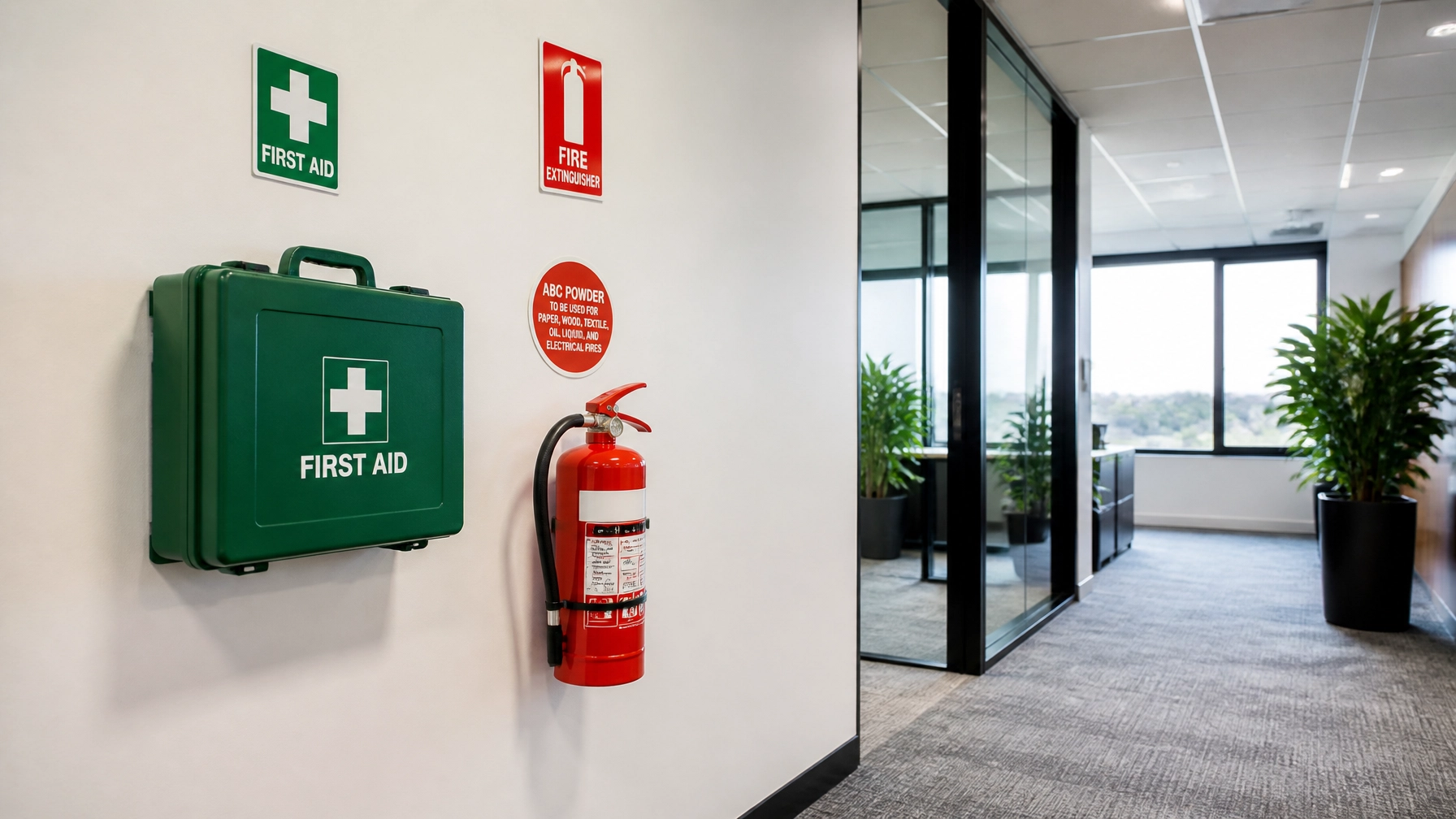
What is Workplace First Aid all about?
Workplace First Aid is the immediate care provided to an employee or visitor who is injured or becomes ill while at work. It is more than just a box of bandages; it is a comprehensive system designed to preserve life, prevent a condition from worsening, and promote recovery. In Australia, providing adequate first aid facilities is a legal requirement under the Safe Work Australia Model Code of Practice.
This system includes three core components: the physical equipment (kits and facilities), the procedures (how your team responds to an emergency), and the people (trained staff members). When these three elements work together, your workplace becomes a safer environment. However, when one part fails, it can lead to non-compliance, legal issues, or, in the worst cases, preventable tragedies. Professional First Aid Training ensures your team is ready to act when every second counts.
1. The "Set and Forget" Kit Mentality
Many businesses in Albury / Wodonga buy a first aid kit, mount it on the wall, and never look at it again until an emergency happens. This is a critical error.
Kits are often found with missing items or expired sterile products. Saline solution, antiseptic wipes, and even some bandages have expiry dates. Once these dates pass, the items may no longer be sterile or effective. Using an expired bandage on a wound can lead to infection, which complicates the recovery process.
How to fix it:
- Appoint a First Aid Officer: Nominate a specific person to be responsible for the kit.
- Schedule monthly checks: Set a recurring calendar invite to inspect kit contents.
- Replace items immediately: If a plaster (adhesive dressing) is used, restock the kit that day.
- Audit expiry dates: Check every item and replace anything nearing its end-of-life.

2. Letting Your HLTAID011 Certifications Lapse
A common mistake is assuming that once a staff member is trained, they are "set for life." In reality, life-saving skills are perishable. If you do not practice the techniques, you will forget the correct compression depth for CPR or the proper steps for treating shock.
For compliance, the standard Workplace First Aid certification, officially known as HLTAID011 Provide First Aid, is generally recommended for renewal every three years. However, the CPR component (which is part of the course) should be refreshed every 12 months to maintain peak competency. If your first aiders are operating on an expired certificate, your business may not be meeting its safety obligations.
How to fix it:
- Keep a training register: Track the expiry dates of all staff certifications.
- Book annual refreshers: Ensure your team can Learn CPR in Albury / Wodonga every year.
- Organise Corporate First Aid training: Yatson Training provides flexible, on-site training to keep your entire team compliant in one go. Call us on 0450 533 179 to schedule your next session.
3. Ignoring the "Lone Ranger" Problem
Is your only trained first aider currently on annual leave? Is there a first aider on the night shift? Many organisations fail to account for staff turnover, sick leave, or multiple shifts. Relying on just one or two people means that if an accident occurs when they are away, no one on-site has the authority or knowledge to lead the response.
How to fix it:
- Calculate your ratios: Safe Work Australia suggests at least one first aider for every 50 workers in low-risk workplaces, and one for every 25 in high-risk environments.
- Cross-train multiple departments: Ensure every floor or department has at least two trained individuals.
- Update your signage: Make sure all staff know exactly who the current first aiders are and how to contact them.

4. Hesitating to Call Triple Zero (000)
We often see a "wait and see" approach in the workplace. Employees might hesitate to call for an ambulance because they don't want to cause a scene or they aren't sure if the injury is "serious enough." This delay can be fatal in cases of cardiac arrest or severe allergic reactions (anaphylaxis).
How to fix it:
- Implement a "No-Blame" policy: Encourage staff to call 000 whenever they are in doubt. It is better to have paramedics arrive and find the situation stable than to call them too late.
- Post emergency procedures: Display clear instructions near every phone on how to call for help and what information to provide (e.g., the workplace address and nearest cross-street).
5. Poor Accessibility and Signage
If a guest collapses in your lobby, can your staff find the first aid kit within 60 seconds? In many workplaces, kits are locked in a manager's office, hidden in a cluttered storeroom, or placed in a location without a clear sign. If the kit isn't "as close to immediate as practicable" (a requirement of the Code of Practice), it is essentially useless during a crisis.
How to fix it:
- Use high-visibility signage: Install white-on-green "First Aid" signs that are visible from a distance.
- Remove locks: First aid kits should never be locked. If security is a concern, use a tamper-evident seal that can be easily broken.
- Ensure clear paths: Never stack boxes or equipment in front of a first aid station.
6. Neglecting Mobile or Remote Workers
Does your team include delivery drivers, sales reps, or technicians who work off-site? Many businesses focus on the head office but forget about their mobile workforce. If a staff member is involved in a vehicle accident or injured at a remote site, they must have immediate access to a portable kit.
How to fix it:
- Equip every vehicle: Provide a dedicated portable first aid kit for every company car or van.
- Secure the kits: Ensure the kits are stored in a way that they won't become projectiles in a crash (e.g., in a secured bracket or the boot).
- Provide specific training: If your team works with children, ensure they have completed a Childcare First Aid course HLTAID012 to handle pediatric emergencies.

7. Mismanaging the Scene (Moving the Casualty)
A common instinct when someone falls is to help them up immediately. However, if the person has a head, neck, or spinal injury, moving them can cause permanent paralysis. Without the right Life-saving skills, well-meaning staff members can inadvertently make an injury much worse.
How to fix it:
- Follow DRSABCD: (Danger, Response, Send for help, Airway, Breathing, CPR, Defibrillation). This acronym is the gold standard for Australian first aid.
- Train for reality: Real-world training, like the sessions led by Registered Nurse Jackie Hislop at Yatson Training, focuses on how to assess a scene before acting.
- Enforce a "Stay Put" rule: Teach staff that unless there is an immediate danger (like a fire), an injured person should generally stay where they are until a first aider or paramedic arrives.
Our recommendation
To ensure your workplace is truly safe, we recommend a "Whole-of-Business" approach. Don't just tick a box; build a culture of safety. This starts with high-quality, hands-on Corporate First Aid training.
Keep in mind that standard compliance is the bare minimum. To provide the best care for your team, you should:
- Incorporate AED (Defibrillator) training for all staff.
- Conduct "mock emergencies" to test your evacuation and first aid response.
- Review your first aid arrangements every time your workplace layout changes or new staff are hired.
For professional, engaging, and compliant training that exceeds standard requirements, contact Yatson Training today on 0450 533 179.
FAQ: Workplace First Aid Essentials
Is First Aid training mandatory for my business?
Yes. Under Australian WHS laws, all employers must provide access to first aid equipment, facilities, and a sufficient number of trained first aiders.
How often should we update our First Aid kits?
Items should be replaced as soon as they are used. A full audit of expiry dates should occur at least every 6 months, though monthly checks are best practice.
What is the difference between HLTAID011 and HLTAID012?
HLTAID011 Provide First Aid is the standard workplace requirement. HLTAID012 is specifically designed for educators and support workers in childcare and school settings, covering additional pediatric-specific emergencies.
Can we do the training at our office?
Absolutely. Yatson Training specialises in on-site Corporate First Aid training in the Albury / Wodonga area and surrounds. We bring the equipment to you to minimise disruption to your workday.
Ready to secure your workplace safety?
Don't wait for an accident to find out your team isn't prepared. Get your Workplace First Aid certification sorted with the experts.
Contact Yatson Training:
- Phone: 0450 533 179
- Website: yatsontraining.com.au
- Follow us on Social Media: Facebook | Instagram
#FirstAidTraining #AlburyWodonga #WorkplaceSafety #HLTAID011 #CPR #CorporateTraining #SafetyFirst #FirstAidMistakes #LifeSavingSkills
{“@type”:”BlogPosting”,”about”:[{“name”:”First Aid Training”,”@type”:”Thing”},{“name”:”Workplace Safety”,”@type”:”Thing”}],”image”:”https://cdn.marblism.com/yDG-meHeMMZ.webp”,”author”:{“name”:”Yatson Training”,”@type”:”Organization”},”@context”:”https://schema.org”,”headline”:”7 Mistakes You’re Making with Your Workplace First Aid (and How to Fix Them)”,”publisher”:{“logo”:{“url”:”https://cdn.marblism.com/-8AyRUBMjeY.png”,”@type”:”ImageObject”},”name”:”Yatson Training”,”@type”:”Organization”},”mainEntity”:{“@type”:”FAQPage”,”mainEntity”:[{“name”:”Is First Aid training mandatory for my business?”,”@type”:”Question”,”acceptedAnswer”:{“text”:”Yes. Under Australian WHS laws, all employers must provide access to first aid equipment, facilities, and a sufficient number of trained first aiders.”,”@type”:”Answer”}},{“name”:”How often should we update our First Aid kits?”,”@type”:”Question”,”acceptedAnswer”:{“text”:”Items should be replaced as soon as they are used. A full audit of expiry dates should occur at least every 6 months.”,”@type”:”Answer”}}]},”description”:”Learn the most common workplace first aid mistakes and how to fix them to stay compliant with Safe Work Australia standards. Professional training in Albury / Wodonga.”,”datePublished”:”2026-06-30″,”mainEntityOfPage”:{“@id”:”https://yatsontraining.com.au/insights/7-workplace-first-aid-mistakes”,”@type”:”WebPage”}}