When an emergency happens in the workplace, every second counts. Whether you are in a retail shop in Albury or a manufacturing plant in Wodonga, knowing exactly what to do can be the difference between a close call and a tragedy. At Yatson Training, we specialise in making these life-saving skills easy to learn and impossible to forget.
Our lead trainer, Jackie Hislop (a Registered Nurse with years of clinical experience), ensures that every session is more than just a compliance tick-box. We focus on hands-on, interactive learning that builds real confidence. One of the most critical tools we teach in our HLTAID011 Provide First Aid course is the DRSABCD framework.
What is the DRSABCD framework all about?
The DRSABCD framework (pronounced 'doctors-ABCD') is a systematic action plan used by first responders to assess and manage a casualty. It is the gold standard for basic life support in Australia, as recommended by the Australian Resuscitation Council (ARC).
Think of it as a mental checklist that keeps you calm when things get chaotic. It ensures you don't skip vital steps, like checking for danger or calling for help, before you start physical interventions like CPR. Its primary function is to preserve life and prevent the casualty's condition from worsening while professional medical help is on the way.
The DRSABCD Steps: A Practical Guide
Following the DRSABCD sequence ensures you provide the most effective care in the correct order. Here is the step-by-step process we teach in our Corporate First Aid training sessions.
D – Danger
Before you rush in, you must ensure the area is safe for everyone involved.
- Check the surrounding area for hazards (such as live wires, oncoming traffic, or chemical spills).
- Remove any immediate threats if it is safe to do so.
- Ensure your own safety first; you cannot help someone else if you become a casualty too.
R – Response
Determine if the casualty is conscious and alert.
- Talk to the person loudly (e.g., "Can you hear me?" or "Open your eyes").
- Squeeze their shoulders firmly (but do not shake them).
- Look for any movement or verbal response.

S – Send for help
If the person does not respond, you need professional assistance immediately.
- Call 000 (the Australian emergency number).
- Designate a specific person to make the call if others are present.
- Request an ambulance and an Automated External Defibrillator (AED).
A – Airway
Check if the casualty's breathing passage is clear.
- Open the mouth and look for obstructions (such as food, vomit, or blood).
- Tilt the head back gently (head tilt-chin lift) to open the airway.
- Clear any visible blockages by rolling the casualty onto their side (the recovery position) and using your fingers if necessary.
B – Breathing
Check for normal, rhythmic breathing.
- Look for the chest rising and falling.
- Listen for breath sounds near their mouth and nose.
- Feel for air on your cheek.
- Act immediately if they are not breathing or breathing abnormally (gasping).
C – CPR (Cardiopulmonary Resuscitation)
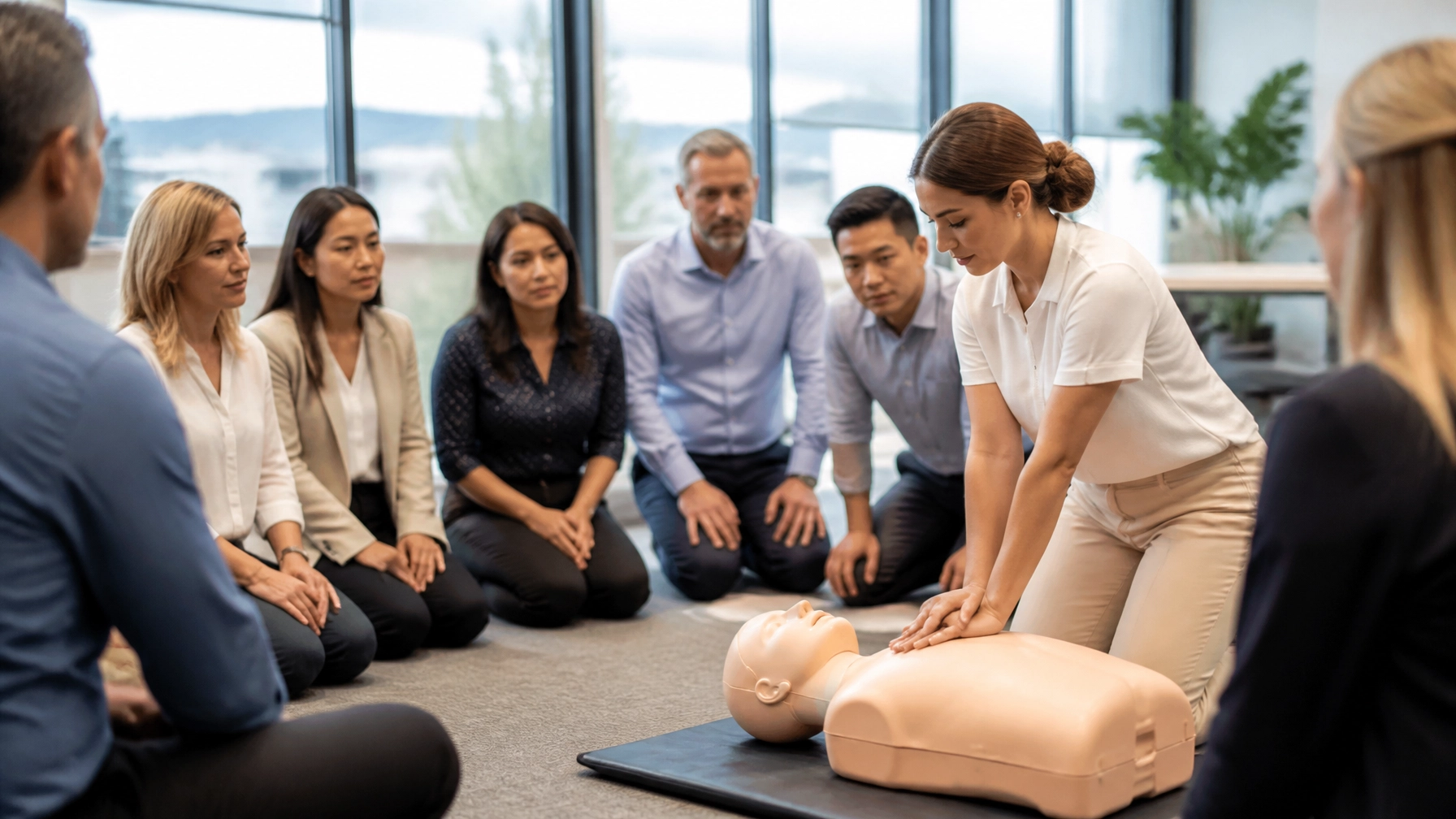
If the casualty is unresponsive and not breathing normally, you must start CPR. This is a core component of our Workplace First Aid certification.
- Place the heel of one hand in the centre of the chest and the other hand on top.
- Perform 30 chest compressions (pushing down about one-third of the chest depth).
- Provide 2 rescue breaths (if you are trained and willing).
- Maintain a rate of 100–120 compressions per minute (to the beat of 'Stayin' Alive').

D – Defibrillation
An AED can significantly increase the chances of survival for someone in cardiac arrest.
- Turn on the AED as soon as it arrives.
- Attach the pads to the casualty's bare chest as shown in the diagrams.
- Follow the voice prompts provided by the machine.
- Stand back when the machine analyses the heart rhythm or delivers a shock.
Our recommendation
At Yatson Training, we recommend that every Albury / Wodonga business conducts a first aid risk assessment at least once a year. While the DRSABCD steps are easy to read, they require muscle memory to execute effectively under pressure.
Keep in mind: Standard compliance is the bare minimum. True safety comes from a team that feels empowered and practised. Don't wait for an accident to happen before you realise your staff's skills have faded.

Why Choose Yatson Training for Your Team?
We know that Life-saving skills are serious business, but that doesn't mean the training has to be boring. We pride ourselves on:
- Expert Instruction: Jackie Hislop (RN) brings real-world medical expertise to every class.
- Flexibility: We come to your Albury or Wodonga workplace to minimise disruption to your day.
- Comprehensive Courses: From general workplace safety to the specialised Childcare First Aid course HLTAID012, we cover it all.
- Full Support: We help you from the first booking through to the issuance of your certificates.
If you want to Learn CPR in Albury / Wodonga from trainers who actually care about your team's success, look no further.
Contact Us Today
Ready to book your next session? Telephone Yatson Training today on 0450 533 179 to discuss your requirements. We offer competitive rates for corporate groups and small teams.
Yatson Training
Phone: 0450 533 179
Website: yatsontraining.com.au
Follow us for tips and updates: Facebook | Instagram | LinkedIn
Frequently Asked Questions
How often should I refresh my DRSABCD skills?
The Australian Resuscitation Council recommends that CPR skills (the 'C' in DRSABCD) be refreshed every 12 months, while a full first aid qualification should be renewed every three years.
Is the DRSABCD framework different for children?
The basic sequence remains the same, but the techniques for airway management and CPR compressions are adapted for infants and children. Our Childcare First Aid course HLTAID012 covers these vital differences in detail.
Can I get in trouble if I perform DRSABCD incorrectly?
In Australia, "Good Samaritan" laws generally protect individuals who provide first aid in good faith during an emergency. The biggest risk is not doing anything at all. Professional training gives you the confidence to act correctly.
Do I need an AED in my office?
While not always legally mandated for every small business, having an AED on-site is highly recommended by Safe Work Australia. It is a critical part of the 'D' in DRSABCD and can save lives in the minutes before an ambulance arrives.
#FirstAidTraining #AlburyWodonga #WorkplaceSafety #DRSABCD #CPR #HLTAID011 #CorporateTraining #LifeSavingSkills
{“name”:”How to Perform the DRSABCD First Aid Framework”,”step”:[{“name”:”Danger”,”text”:”Check the area for hazards to yourself, the casualty, and bystanders.”,”@type”:”HowToStep”},{“name”:”Response”,”text”:”Check if the casualty is conscious by talking to them and squeezing their shoulders.”,”@type”:”HowToStep”},{“name”:”Send for help”,”text”:”Call 000 for emergency services and ask for an ambulance and an AED.”,”@type”:”HowToStep”},{“name”:”Airway”,”text”:”Open the casualty’s mouth and check for obstructions. Tilt the head back to clear the airway.”,”@type”:”HowToStep”},{“name”:”Breathing”,”text”:”Look, listen, and feel for normal breathing for up to 10 seconds.”,”@type”:”HowToStep”},{“name”:”CPR”,”text”:”If not breathing, start 30 chest compressions followed by 2 rescue breaths.”,”@type”:”HowToStep”},{“name”:”Defibrillation”,”text”:”Attach an AED as soon as possible and follow the voice prompts.”,”@type”:”HowToStep”}],”@type”:”HowTo”,”image”:”https://cdn.marblism.com/hgv4jTTQm-L.webp”,”@context”:”https://schema.org”,”totalTime”:”PT10M”,”description”:”A step-by-step guide to the DRSABCD basic life support framework used in Australian workplaces.”}