What is using an AED in the workplace all about?
An automated external defibrillator (AED) is a portable device that assesses a person’s heart rhythm and delivers an electrical shock when it detects a shockable rhythm. The shock may help the heart return to an organised rhythm.
An AED does not replace CPR. Use it as part of the chain of survival:
- Recognise cardiac arrest.
- Call Triple Zero (000).
- Push by starting CPR.
- Shock by using an AED as soon as it is available.
Cardiac arrest is different from a heart attack. A person in cardiac arrest is usually unconscious and not breathing normally. A heart attack usually causes symptoms such as chest pain or pressure while the person remains conscious. A heart attack can, however, lead to cardiac arrest.
An AED provides spoken and visual instructions. Anyone can use one in an emergency. You do not need to wait for a first aider or medical professional if an AED is available.
Why should Albury Wodonga workplaces consider an AED?
There is no general Australian law requiring every workplace to have an AED. However, employers must manage foreseeable health and safety risks so far as is reasonably practicable.
For workplaces across Albury, Wodonga and surrounding regional areas, an AED can provide an important additional control during a cardiac emergency. Ambulance response times may vary according to location, traffic, weather and demand. Immediate CPR and early defibrillation can begin before paramedics arrive.
Consider an AED as part of your workplace risk assessment if you have:
- A large workforce or high visitor numbers.
- Workers who perform physically demanding tasks.
- A warehouse, factory, construction site or outdoor work area.
- Multiple buildings, floors or work zones.
- A sports, recreation, retail, education or community facility.
- A workplace located some distance from emergency medical services.
- Staff, visitors or clients with known health risks.
- Extended operating hours or workers on site outside standard office hours.
An AED should complement, not replace:
- Workplace first aid procedures.
- Suitable first aid kits.
- Trained first aiders.
- Emergency communication systems.
- Clear access routes for emergency services.
- Regular CPR and first aid training.
WorkSafe Victoria’s AED guidance recommends that employers consider whether an AED is reasonably practicable for their workplace. It also stresses that AEDs should be visible, accessible and maintained.

How to use an AED alongside CPR
Follow your training, the AED’s prompts and current Australian Resuscitation Council guidance. In an actual emergency, call Triple Zero (000) immediately and follow the emergency operator’s instructions.
1. Check for danger
Check that the area is safe for you, the casualty and bystanders. Do not rush into a situation involving live electricity, fire, traffic, chemicals or other hazards.
2. Check the casualty
Check for a response. Speak loudly and gently tap the person’s shoulders.
If the person is unresponsive, check whether they are breathing normally. Occasional gasping is not normal breathing.
3. Call Triple Zero (000)
Direct someone to call Triple Zero (000) and explain that the person is unconscious and not breathing normally.
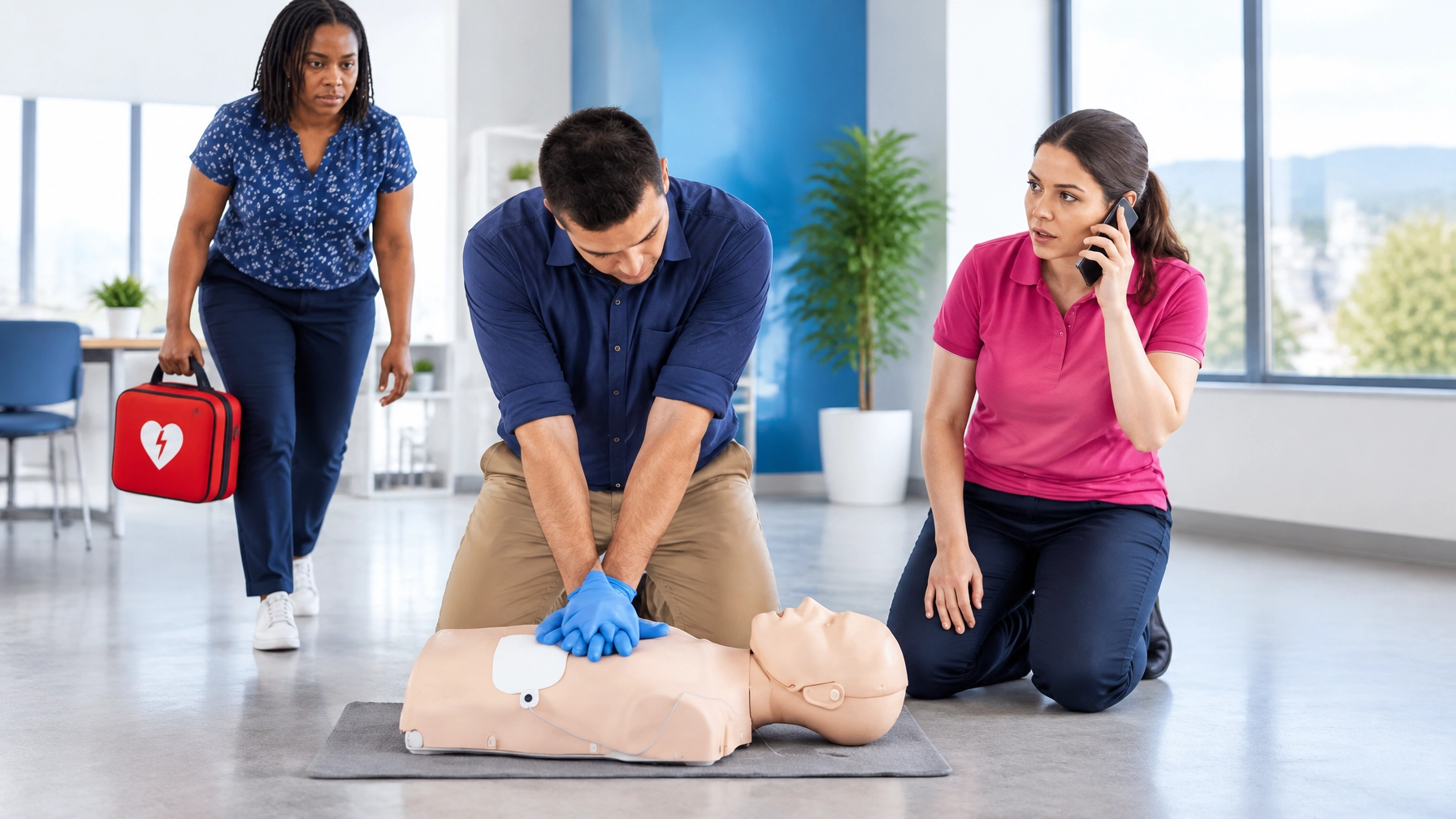
Send another person to retrieve the workplace AED and first aid kit. Ask someone to meet the ambulance at the entrance and guide paramedics to the casualty.
4. Start CPR
Begin CPR immediately if the person is unconscious and not breathing normally.
- Place the casualty on their back on a firm, flat surface.
- Kneel beside the chest.
- Place the heel of one hand in the centre of the chest and the other hand on top.
- Keep your arms straight.
- Push hard and fast at a rate of approximately 100–120 compressions per minute.
- Allow the chest to recoil after each compression.
- Minimise interruptions.
If you are trained and willing to provide rescue breaths, use the CPR method taught in your course. If you are not able to provide breaths, continue chest compressions until the AED is ready or help arrives.
5. Turn on the AED
When the AED arrives, turn it on. Some devices switch on when the lid is opened.
Listen carefully to the instructions. Continue CPR while another responder prepares the AED, unless the device tells you to stop.
6. Expose and prepare the chest
Remove clothing from the chest. Dry the chest if it is wet.
Do not use an AED in standing water. Move the casualty to a dry location if this can be done safely.
If the casualty has a visible pacemaker or implanted cardiac device, avoid placing a pad directly over it. Follow the pad diagrams and the device instructions.
7. Apply the pads
Peel the backing from the adhesive pads and apply them to the bare chest as shown on the pad diagrams. For an adult, this is generally one pad on the upper right chest and one on the lower left side of the chest.
Press the pads firmly so they adhere properly. Do not place pads over medication patches. Remove the patch with gloved hands if necessary and wipe the area before applying the pad.
8. Stand clear during analysis
Tell everyone to stop CPR and not touch the casualty while the AED analyses the heart rhythm.
Say clearly, “Stand clear.” Check that nobody is touching the casualty, the bed or any connected equipment.
9. Deliver the shock if instructed
If the AED advises a shock, make sure everyone is clear. Press the shock button if the device instructs you to do so.
Do not touch the casualty while the shock is delivered.
10. Resume CPR immediately
Resume CPR as soon as the AED tells you to. Continue following the device prompts.
The AED may advise “no shock.” This does not mean the casualty is safe. Continue CPR and follow the AED’s instructions until:
- The person shows signs of life and begins breathing normally.
- Paramedics take over.
- The area becomes unsafe.
- You are physically unable to continue.
Where should you place an AED?
Place your AED where it can be reached quickly. A common planning objective is for a responder to retrieve the device and return to the casualty within approximately three minutes.
Choose a location that is:
- Visible and clearly signed.
- Central to the main work area.
- Accessible during all operating hours.
- Unlocked and available without needing a key.
- Protected from extreme heat, cold, moisture, dust and direct sunlight.
- Close to the first aid kit where practical.
- Known to employees, contractors and regular visitors.
Suitable locations may include a reception area, main corridor, lunchroom, security desk or central administration area.
Large Albury Wodonga workplaces may need more than one AED. Consider the distance between buildings, multiple floors, outdoor work zones, locked gates and shift arrangements. Document the decision in your workplace first aid risk assessment.
Registering the device with the relevant ambulance service may also help emergency operators identify its location.
AED maintenance checklist
An AED is only useful if it is ready to operate. Nominate a responsible person and record inspections.
At least monthly, check that:
- The readiness indicator shows the device is operational.
- The AED is present in its designated location.
- The cabinet is accessible and clearly signed.
- The pads are sealed, undamaged and within their expiry date.
- The battery is installed and within its service life.
- Cables and connectors are intact.
- The device has not been exposed to unsuitable conditions.
- Any associated CPR mask, gloves or first aid supplies are available.
Replace pads after use and before their expiry date. Replace batteries according to the manufacturer’s instructions. Record every inspection, replacement and use.
Do not rely only on a green light or self-test indicator. Follow the manufacturer’s maintenance requirements and arrange servicing when the device reports an error.
How Yatson Training covers AED use
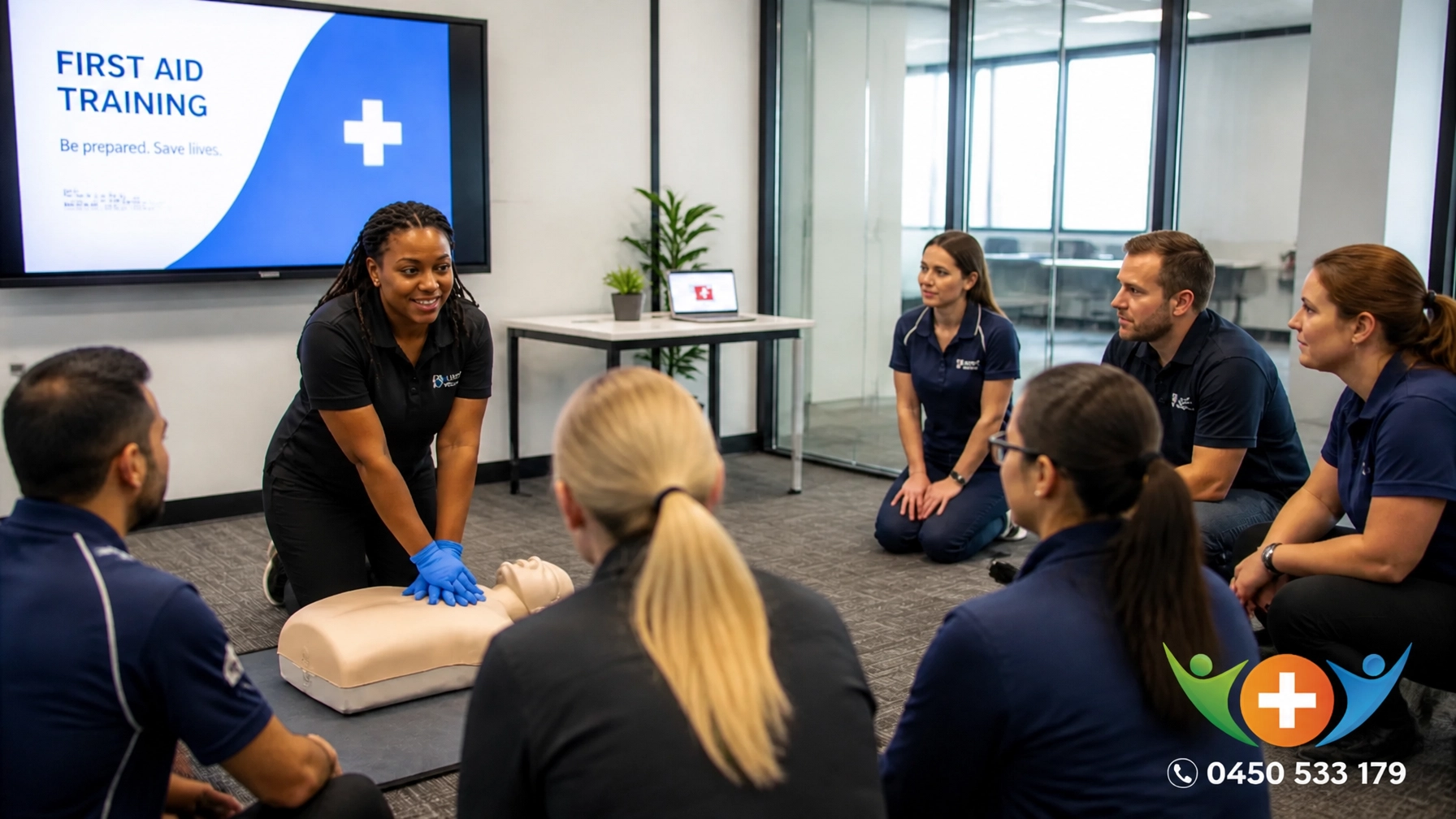
Yatson Training delivers practical, hands-on HLTAID009 Provide CPR and HLTAID011 Provide First Aid training for workplaces, small groups and individuals across Albury Wodonga.
The training includes practical scenarios using AED training devices. Participants practise how to:
- Recognise an unconscious casualty who is not breathing normally.
- Call Triple Zero (000) and communicate essential information.
- Start and maintain effective CPR.
- Apply AED pads correctly.
- Follow voice and visual prompts.
- Keep people clear during analysis and shock delivery.
- Resume CPR without unnecessary delay.
- Work as a team during an emergency.
- Report and review the incident afterwards.
The nationally recognised HLTAID009 unit details include performing CPR in line with ARC guidelines and operating an AED according to the manufacturer’s instructions.
HLTAID011 Provide First Aid includes CPR and AED response as part of a broader first aid response to workplace injuries and illnesses. For education and care workplaces, ask about the Childcare First Aid course HLTAID012.
Yatson Training provides support from your first enquiry through to training and certification. Lead trainer Jackie Hislop is a Registered Nurse, and sessions are designed to be interactive, clear and relevant to your workplace.

Keep in mind
An AED does not guarantee survival. It cannot correct every cardiac rhythm. It must not delay CPR, the 000 call or professional medical care.
Your workplace should combine equipment with regular practice. Include the AED in emergency drills. Show staff where it is located. Check that new employees, contractors and shift workers know how to access it.
Current training also matters. Refresh your CPR skills at least annually, or more often if required by your workplace, industry or regulator. Confirm your Workplace First Aid certification remains current and aligned with your duties.
Our recommendation for Albury Wodonga workplaces
Complete a site-specific AED and first aid review. Map the distance from likely incident areas to the AED. Confirm that the device is accessible after hours. Update signage and emergency procedures. Train enough staff to provide coverage across all shifts.
For reliable Corporate First Aid training, contact Yatson Training to discuss a flexible session for your team. You can also arrange training for a small group or enrol as an individual to Learn CPR in Albury Wodonga.

Frequently asked questions
Do I need formal training to use an AED?
No. AEDs are designed to guide the user. However, professional CPR and first aid training helps you recognise cardiac arrest, start CPR promptly, use the device correctly and work effectively with others.
Is an AED compulsory in every Australian workplace?
No. There is no general requirement for every workplace to have one. Your business should consider AED provision as part of its WHS risk assessment and first aid arrangements.
Is CPR training still necessary if we have an AED?
Yes. CPR supports circulation while the AED is retrieved and prepared. Staff must also know how to assess the casualty, call 000 and continue CPR between AED prompts.
Is AED training included in HLTAID009 and HLTAID011?
Yes. Both units include AED operation in a simulated assessment environment. Training.gov.au provides the current unit information.
How do I organise workplace training?
Call Yatson Training on 0450 533 179 to discuss your team size, workplace location and training requirements. Visit yatsontraining.com.au for course information and enquiries.
Book professional First Aid training
Do not wait until an emergency exposes gaps in your workplace response. Telephone Yatson Training on 0450 533 179 for First Aid Training Albury Wodonga, HLTAID009 Provide CPR, HLTAID011 Provide First Aid and practical Corporate First Aid training.
Yatson Training offers flexible, hands-on training for corporate clients, small groups and individuals.
Follow Yatson Training on Facebook, Instagram and YouTube.
#FirstAidTraining #AEDTraining #CPRTraining #HLTAID009 #HLTAID011 #AlburyWodonga #WorkplaceSafety #CorporateFirstAidTraining #WorkplaceFirstAidCertification #LearnCPR #FirstAidTrainingAlburyWodonga