Community sport is the heartbeat of the Albury-Wodonga region. On any given weekend, thousands of residents head to local ovals and courts for AFL, netball, cricket, and soccer. While we focus on the scores and the physical benefits of playing, the reality of physical exertion means that medical emergencies can happen.
In Wodonga alone, participation in official clubs is high, with thousands of registered players across various age groups. Because emergency response times in regional areas can vary, the people on the sidelines, the coaches, parents, and volunteers, are often the first line of defence. When a player or spectator collapses from sudden cardiac arrest, your immediate actions determine the outcome.
To ensure your club is prepared, you need to Learn CPR in Albury / Wodonga through a professional course like HLTAID011 Provide First Aid.
What is CPR all about?
CPR (cardiopulmonary resuscitation) is an emergency procedure used when someone’s heart has stopped beating or they have stopped breathing. Its primary function is to manually pump blood around the body to keep the brain and vital organs alive until professional medical help arrives. In a sporting context, it is the bridge between a life-threatening collapse on the field and a successful recovery in a hospital.
Immediate Recognition and the DRSABCD Protocol
The first skill every sideline hero needs is the ability to recognise a cardiac arrest quickly. In the heat of a game, a collapse might look like a simple trip or a faint. However, if the person is unresponsive and not breathing normally, you must act.
- Check for danger to yourself and the casualty (clear the players and equipment from the area).
- Response: Ask the casualty to squeeze your hand or open their eyes.
- Send for help by calling Triple Zero (000) and asking for an ambulance.
- Airway: Open the mouth and check for obstructions (like a mouthguard).
- Breathing: Look, listen, and feel for normal breaths for up to 10 seconds.
- CPR: Start compressions if breathing is absent or abnormal.
- Defibrillation: Attach an AED (automated external defibrillator) as soon as it arrives.
Using the DRSABCD protocol ensures that you do not miss vital steps during a high-pressure situation on the sidelines.

High-Quality Chest Compressions
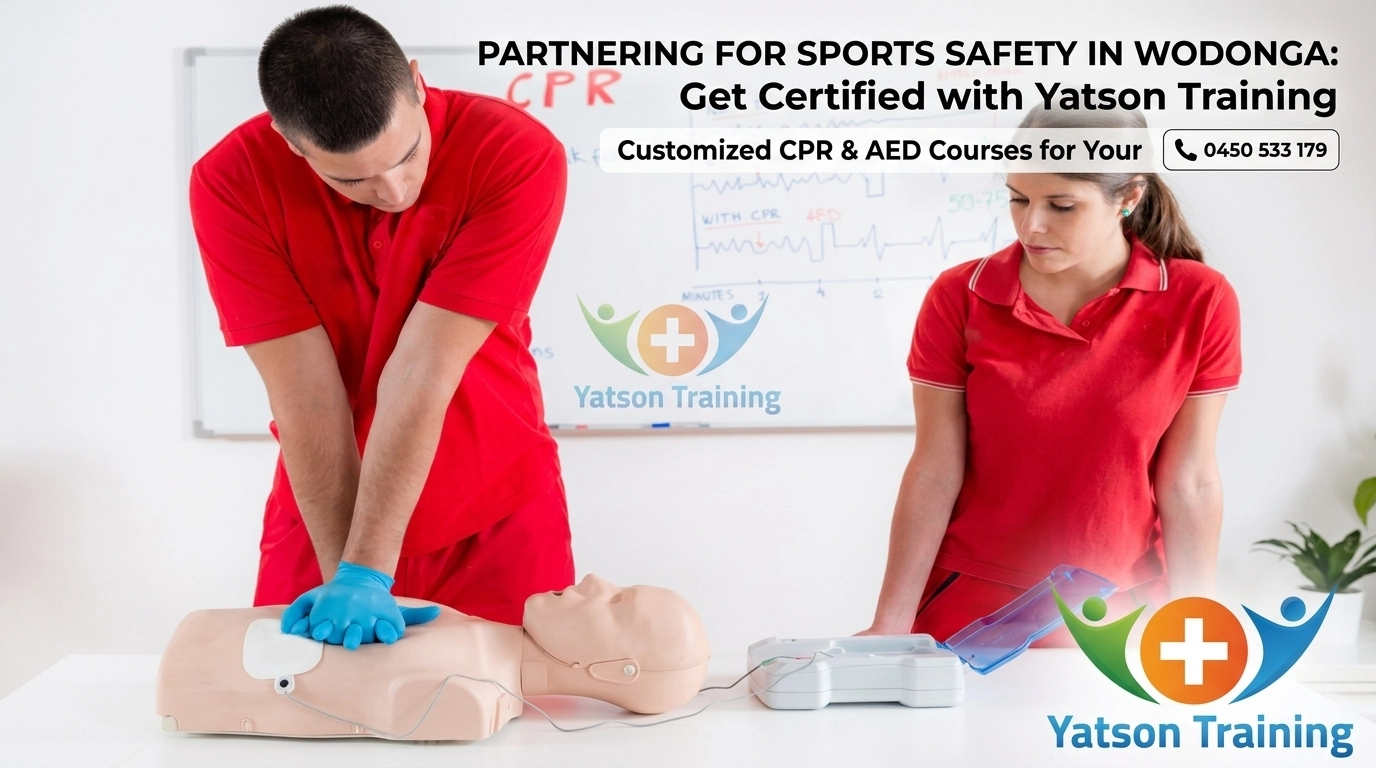
Effective chest compressions are the core of First Aid Training for Sporting Groups. If your compressions are too shallow or too slow, the blood will not reach the brain.
- Position the heel of your hand in the centre of the casualty’s chest.
- Lock your elbows and use your body weight to push down.
- Compress to a depth of at least 5cm (about one-third of the chest depth).
- Maintain a rate of 100–120 compressions per minute (roughly the beat of 'Stayin' Alive').
- Allow the chest to fully recoil between each compression.
If you are trained and willing, provide 2 rescue breaths for every 30 compressions. If not, continue with compressions only. This continuous action keeps the person viable until the ambulance arrives at the sports ground.
Rapid Defibrillation (AED Use)
An AED is a portable device that can shock a heart back into a normal rhythm. Many Wodonga sports facilities now have these on-site, often funded through initiatives like the NSW Local Sport Defibrillator Grant Program.
- Turn the AED on immediately (it will provide voice prompts).
- Attach the pads to the casualty’s bare chest as shown in the diagrams on the pads.
- Clear the area when the machine is analysing the heart rhythm.
- Press the shock button only when instructed by the device.
- Resume CPR immediately after the shock or if no shock is advised.
Research shows that using a defibrillator within the first 3–5 minutes can increase survival rates to over 50%. This is why knowing where your club's AED is located is just as important as knowing how to use it.

First Aid Training for Sporting Groups in Albury / Wodonga
Every club has a responsibility to provide a safe environment for its members. Yatson Training specialises in delivering hands-on, engaging Corporate First Aid training that is specifically tailored to the needs of local organisations.
We understand that volunteers and coaches are busy. That is why we offer flexible training options that can be conducted at your clubrooms or at a time that suits your training schedule. Whether you need a Childcare First Aid course HLTAID012 for junior sports staff or general Workplace First Aid certification, we provide the highest standard of instruction.
Our Recommendation
We recommend that every Wodonga sporting group schedules an annual CPR refresher. Skills can fade over time, and a quick, interactive session ensures that your "sideline heroes" are confident when it matters most.
Our lead trainer, Jackie Hislop, is a Registered Nurse (RN). This medical background means our training goes beyond the manual; we provide real-world insights into what happens during a medical emergency. For group booking rates and tailored sessions for your club, please telephone 0450 533 179.
Keep in Mind
- Time is muscle: For every minute that passes without CPR, the chance of survival drops by 10%.
- Anyone can do it: You do not need to be a doctor to save a life; you just need the right training.
- Update your kit: Ensure your club's first aid kit is stocked and the AED batteries are in-date.

Frequently Asked Questions
Does our club really need a defibrillator?
Yes. Sudden cardiac arrest can happen to anyone, including fit young athletes and older spectators. Having an AED on-site and staff trained to use it is a critical part of modern sports safety and risk management.
Is the training difficult?
No. Yatson Training focuses on making sessions interactive and enjoyable. We move away from dry lectures and focus on hands-on practice (using manikins and AED trainers) so you feel capable of acting in a real emergency.
Can we book a session for our whole coaching staff?
Absolutely. We offer competitive group rates for First Aid Training for Sporting Groups. We can come to your location in Wodonga or Albury to make the process as easy as possible for your volunteers.
How often should we renew our CPR certification?
The Australian Resuscitation Council recommends that CPR skills be refreshed every 12 months to ensure competency and confidence.
Ready to protect your team?
Don't wait for an emergency to happen on your sidelines. Ensure your coaches and volunteers have the skills they need to save a life. For professional, hands-on First Aid training that exceeds compliance requirements, click here to call Yatson Training on 0450 533 179 or visit yatsontraining.com.au.
Follow us for more safety tips and updates:
#FirstAidTraining #AlburyWodonga #WodongaSports #LearnCPR #WorkplaceSafety #HLTAID011 #SidelineHeroes #CommunitySport #YatsonTraining