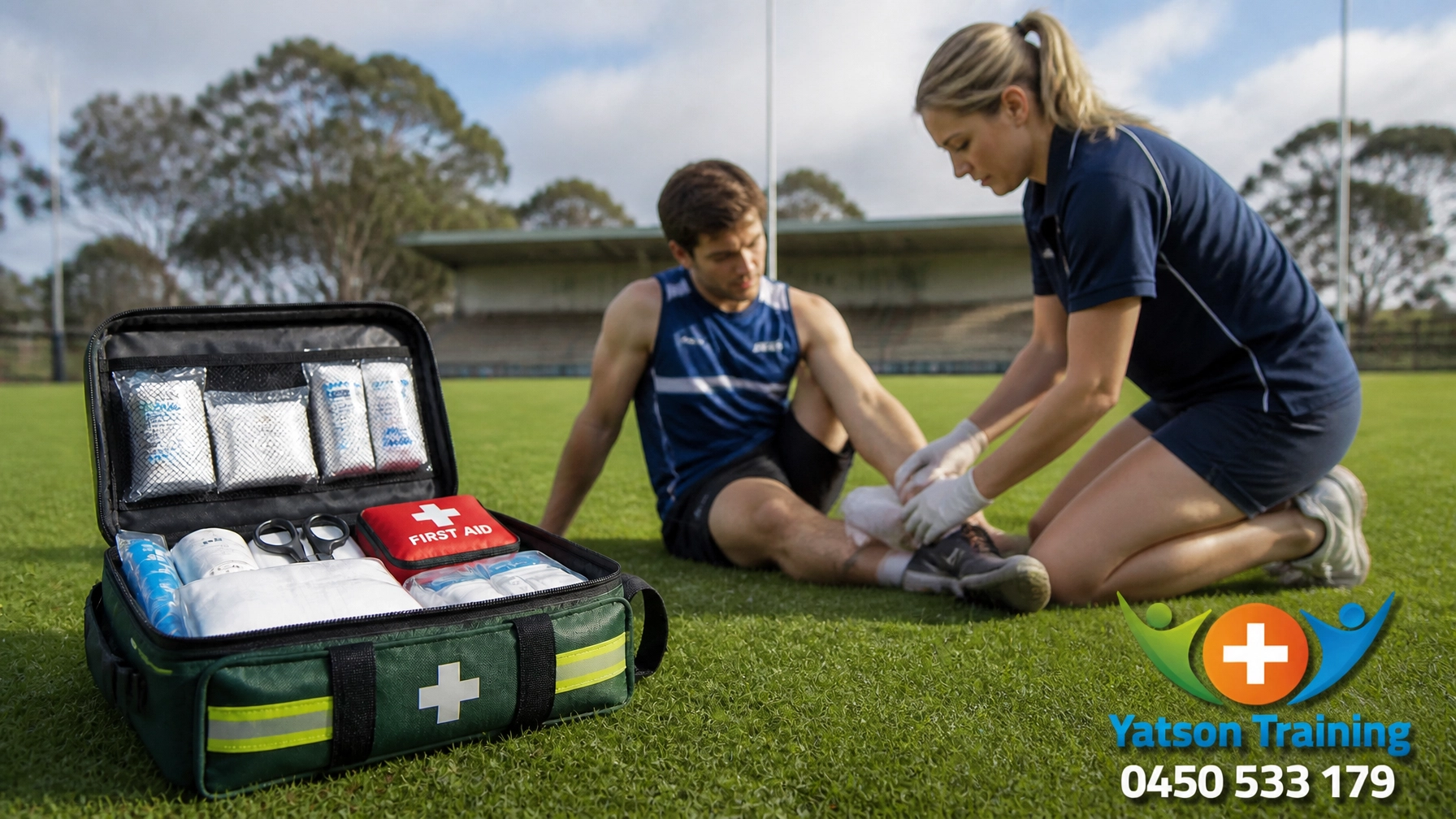

If you walk into most workplaces in Albury / Wodonga, you’ll likely see a white box with a green cross hanging on the wall. It’s one of those things we often take for granted, until an emergency strikes. Whether it’s a minor cut in the office kitchen or a serious incident on a construction site, that kit is your first line of defence.
However, just having a kit isn’t enough. At Yatson Training, we see many businesses making simple but dangerous errors that could land them in hot water with WorkSafe or, worse, leave an employee without the help they need.
What is a workplace first aid kit all about?
At its most basic level, a workplace first aid kit is a collection of supplies and equipment used to provide immediate medical treatment to an injured person. Its primary function is to manage an injury or illness until professional medical help (like an ambulance) arrives or until the person can seek further treatment.
In Australia, providing adequate first aid facilities is a legal requirement under the Work Health and Safety (WHS) Act. This doesn’t just mean buying a box from the chemist. It means ensuring the equipment is relevant to your specific risks, easy to find, and maintained by someone who knows what they are doing. A well-stocked kit, paired with HLTAID011 Provide First Aid training, can literally be the difference between a quick recovery and a permanent disability.
1. Treating a “standard” kit as one-size-fits-all
The mistake: Buying a generic, off-the-shelf kit and assuming your compliance is "done," regardless of whether you run a quiet accounting firm or a high-risk fabrication workshop.
Why it’s a problem: A light-duty office kit rarely contains the heavy-duty dressings needed for a deep laceration from a power tool or the eye-wash stations required for chemical splashes. If your kit doesn't match your risks, it's essentially useless when a specific emergency occurs.
How to fix it:
- Conduct a risk assessment: Look at your workplace. Are there burns? Chemicals? Risk of falls?
- Consult the Code of Practice: Refer to the First Aid in the Workplace Code of Practice for your state.
- Customise: Add specific modules (like a "Burn Module" or "Eye Wound Module") to your base kit based on your findings.
- Think about mobility: If your team works in vehicles or at remote sites around the Albury / Wodonga region, they need portable kits, not just a wall-mounted box in the office.
2. Letting items expire or run out
The mistake: Opening the kit during an emergency only to find that the antiseptic wipes have dried out, the bandages have lost their elasticity, or the saline solution expired three years ago.
Why it’s a problem: Sterile items like dressings and eye pads have expiry dates because the packaging can eventually become porous, allowing bacteria to enter. Using expired products can lead to infections. Furthermore, a kit that was used for a minor scrape last month and never restocked is a kit that will fail you during the next incident.
How to fix it:
- Set a schedule: Mark a date on your calendar every three months to perform a full audit.
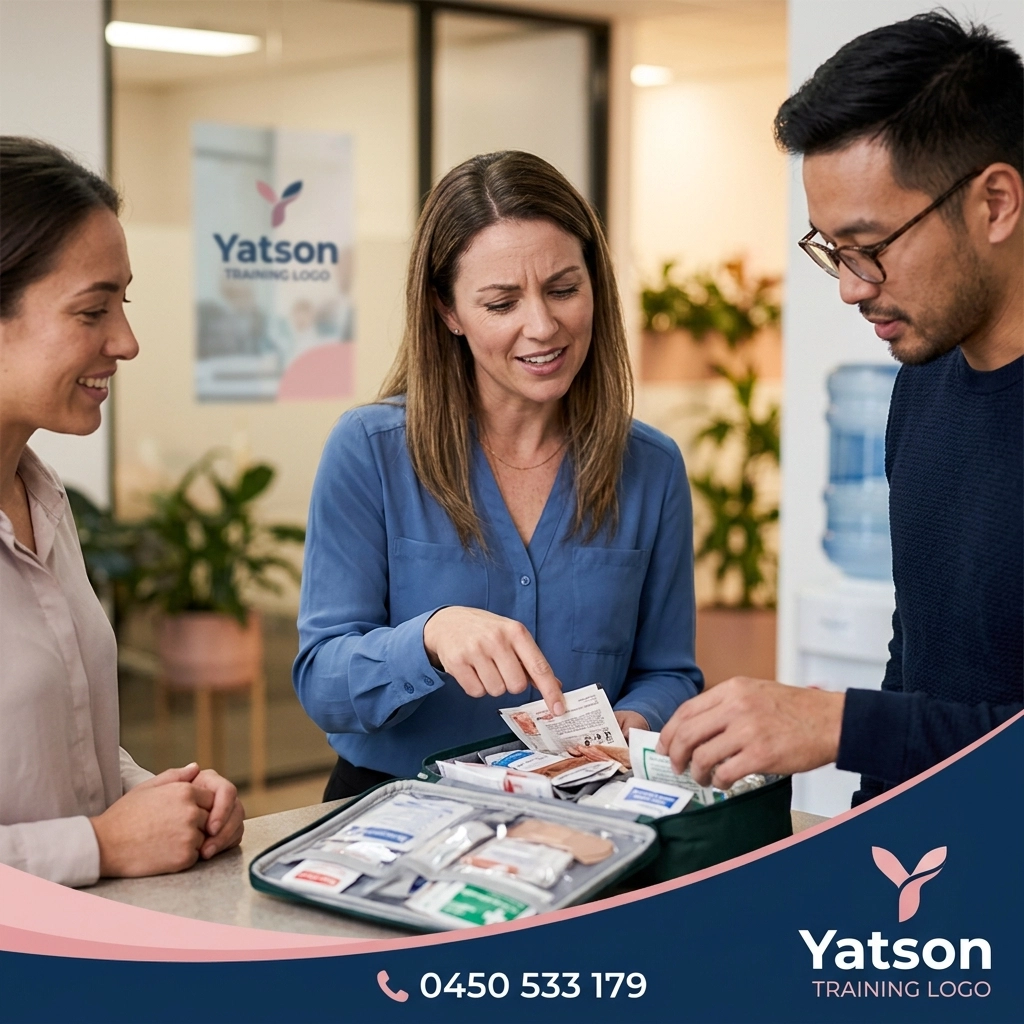
- Use a checklist: Print a list of what should be in the kit and check quantities against it.
- Restock immediately: Make it a policy that if an item is used, the first aider notifies the office manager to order a replacement that day.
- Check seals: Ensure sterile items are still sealed and undamaged.

3. Poor storage, location, and labelling
The mistake: Keeping the kit in a locked manager's office, hidden behind a stack of photocopy paper, or stored in a place that gets hit by direct sunlight.
Why it’s a problem: In an emergency, every second counts. If a staff member has to spend three minutes searching for the kit or finding someone with a key to the office, a manageable bleed can become a life-threatening crisis. Additionally, heat and moisture (common in Albury / Wodonga summers) can degrade the adhesive on plasters and the chemicals in ointments.
How to fix it:
- Make it visible: Mount the kit on a wall in a high-traffic area (like a break room or near an exit).
- Use proper signage: Install a standard green-and-white first aid sign above the kit that is visible from a distance.
- Never lock it: First aid kits must be accessible to everyone at all times.
- Keep it cool and dry: Store it away from damp areas or heat sources.
4. Skipping PPE and infection-control items
The mistake: Focusing entirely on bandages and Band-Aids while forgetting that the person providing the help needs protection, too.
Why it’s a problem: Dealing with blood or bodily fluids carries a risk of cross-contamination and the spread of blood-borne diseases. If your kit doesn't have gloves or a CPR mask, your first aider is putting their own health at risk.
How to fix it:
- Stock non-latex gloves: Ensure you have multiple pairs of disposable gloves (nitrile is best to avoid latex allergies).
- Include a CPR face shield: This is essential for providing breaths safely during Learn CPR in Albury / Wodonga sessions or real-life events.
- Add hand sanitiser and wipes: For cleaning the area around a wound and the hands of the first aider.
- Biohazard bags: Include a way to safely dispose of used dressings and gloves.

5. Overstuffed, disorganised kits
The mistake: Turning the first aid kit into a "junk drawer" for old medications, loose safety pins, and random creams.
Why it’s a problem: When someone is bleeding or panicking, they don't have time to dig through a mountain of loose items to find a pair of shears. Furthermore, workplace kits should generally not contain oral medications (like Panadol or Ibuprofen) unless specifically managed under a strict workplace policy, as they can cause allergic reactions or mask symptoms.
How to fix it:
- Clear the clutter: Remove anything that isn't a standard first aid item.
- Organise by injury: Use clear internal pouches or dividers labelled "Bleeding," "Burns," and "PPE."
- Keep a map: Tape a small diagram inside the lid showing where everything is located.
- Check the contents list: Ensure you aren't carrying three boxes of the same thing while missing others.
6. “Set and forget”: No ownership or inspection routine
The mistake: Assuming that because you bought a kit three years ago, you are still compliant.
Why it’s a problem: Without a designated "Responsible Person," things get missed. Kits get dusty, items go missing, and compliance lapses. During a WorkSafe audit, "I thought someone else was checking it" is not a valid excuse.
How to fix it:
- Appoint a First Aid Officer: This person is responsible for the kits and should ideally hold a Workplace First Aid certification.
- Log your checks: Keep a signed and dated logbook inside the kit. This proves to auditors that you are maintaining your equipment.
- Empower your team: Ensure everyone knows who the First Aid Officer is and how to report a missing item.

7. Not training people to use the kit
The mistake: Having a gold-standard, fully stocked kit but having zero staff members who know how to use it effectively.
Why it’s a problem: A defibrillator (AED) or a complex trauma dressing is just a plastic box or a piece of cloth if no one knows the steps to apply them. Panic sets in when people feel unprepared, leading to mistakes or total inaction.
How to fix it:
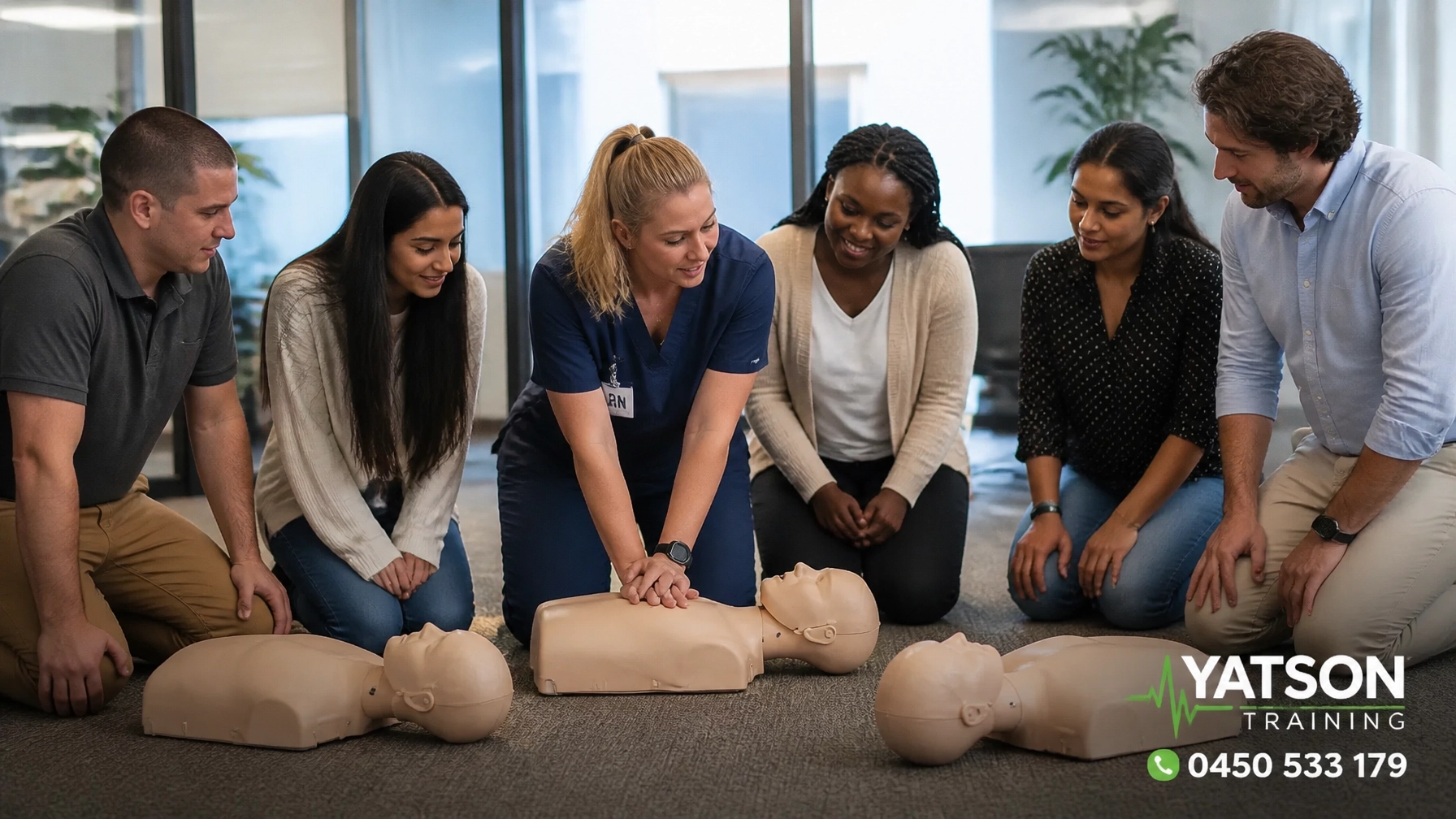
- Book Corporate First Aid training: Invest in HLTAID011 Provide First Aid for a core group of your staff.
- Do an orientation: During staff inductions, show new hires where the kit is and what’s inside.
- Practice scenarios: Use your team meetings to quickly run through a "what if" scenario.
Keep in Mind: Our Recommendation
At Yatson Training, we recommend that every business in the Albury / Wodonga region treats their first aid kit as a living piece of safety equipment. It is not a decoration.
Our top recommendation is to combine your high-quality kit with professional training. Even the best kit in the world can't provide chest compressions or calm a person in shock. If you are unsure if your workplace is compliant, give us a call on 0450 533 179. We provide flexible, hands-on training that ensures your team knows exactly how to use every item in that white box.
If you are looking for a Childcare First Aid course HLTAID012 or a standard workplace refresher, we can come to your site or host you at our Albury / Wodonga facilities.
Frequently Asked Questions
Do I legally need a first aid kit in my office?
Yes. Under Australian WHS law, every workplace must provide first aid equipment, facilities, and a person trained to administer first aid. The scale of this depends on your staff numbers and risk level.
Can I put Panadol or Aspirin in my workplace first aid kit?
Generally, no. Most workplace safety guidelines advise against including medications in general-use kits due to the risk of allergic reactions and incorrect dosing. Stick to dressings, bandages, and antiseptic.
How often should my first aid kit be checked?
We recommend a quick visual check monthly and a detailed audit every three to six months. If a kit is used, it should be restocked immediately.
What training do my employees need?
For most workplaces, the HLTAID011 Provide First Aid course is the standard requirement. For those in childcare or education, HLTAID012 is required.
Is an AED (Defibrillator) mandatory?
While not strictly mandatory for every small office, an AED is highly recommended, especially in high-traffic areas or workplaces with older staff or high physical stress.
Ready to get your workplace safety sorted?
Don't wait for an accident to find out your first aid kit is missing its most important items. Ensure your team has the life-saving skills they need to act with confidence.
Contact Yatson Training today to book your next course!
Phone: 0450 533 179
Website: yatsontraining.com.au
Follow us on Social Media: Facebook | Instagram | LinkedIn
For all your First Aid training needs, call us on 0450 533 179.
#FirstAidTraining #AlburyWodonga #WorkplaceSafety #HLTAID011 #HLTAID012 #CPR #FirstAidKit #WHSCompliance #YatsonTraining