
Staying up to date with first aid isn't just about ticking a box for compliance; it is about having the most effective, science-backed skills to save a life when every second counts. The Australian Resuscitation Council (ANZCOR) has released significant updates for 2026 that streamline how we approach emergencies. Whether you are managing a large team in a warehouse or working in a small office, these changes directly impact your Workplace First Aid certification.
At Yatson Training, we make it our mission to ensure you aren't just "certified," but truly capable. Led by Jackie Hislop, a Registered Nurse (RN) with years of clinical experience, our Life-saving skills training translates these complex medical guidelines into practical, hands-on knowledge you can actually use.
What are the 2026 ANZCOR updates all about?
The 2026 ANZCOR updates are a refined set of clinical guidelines designed to simplify the decision-making process for first aiders. In an emergency, stress can lead to hesitation. These updates aim to remove that "analysis paralysis" by providing clearer, more direct instructions for Cardiopulmonary Resuscitation (CPR) and the management of seriously ill patients.
Essentially, these guidelines serve as the "gold standard" for all Emergency First Aid certification courses in Australia. They are based on the latest international resuscitation science, adapted specifically for the Australian context. If you want to Learn First Aid with Yatson Training, you will be learning these exact protocols to ensure your skills are cutting-edge and compliant with current national standards.
The Australian Resuscitation Council: Setting the Standard
The Australian Resuscitation Council (ANZCOR) is the peak body that represents all major organisations involved in resuscitation and first aid in Australia and New Zealand. They perform the heavy lifting of reviewing global medical research to decide what works best in the "real world."
When you enrol in an HLTAID011 Provide First Aid course, the curriculum is built entirely upon these ANZCOR guidelines. Their goal for 2026 is simple: increase the survival rates of cardiac arrest and sudden illness by making first aid easier to remember and faster to initiate.

Key Change: Starting CPR with Confidence
One of the biggest hurdles for bystanders is the fear of doing the "wrong thing." The 2026 guidelines have doubled down on a simplified decision rule to help you act faster.
- Check for responsiveness: If the person does not respond to touch or talk.
- Check for breathing: Look for normal breathing (not gasping or irregular sounds).
- The New Rule: If the person is unresponsive and not breathing normally, start CPR immediately.
You no longer need to be "certain" that they are in cardiac arrest. ANZCOR explicitly states that performing CPR on someone who doesn't actually need it is unlikely to cause significant harm, whereas delaying CPR for someone who does need it is fatal. When you Learn CPR in Albury / Wodonga with our team, we practice this exact decision-making process so you don't freeze when it matters most.
30:2 Ratio: Simplified for Everyone
Consistency is key to memory. The 2026 updates reinforce the universal compression-to-ventilation ratio.
- The Ratio: 30 chest compressions followed by 2 rescue breaths.
- Universal Application: This applies to infants, children, and adults (30:2 for all ages).
- Focus on Compressions: For those who are untrained or unwilling to give breaths, "hands-only" CPR (continuous compressions) is still strongly encouraged and highly effective.
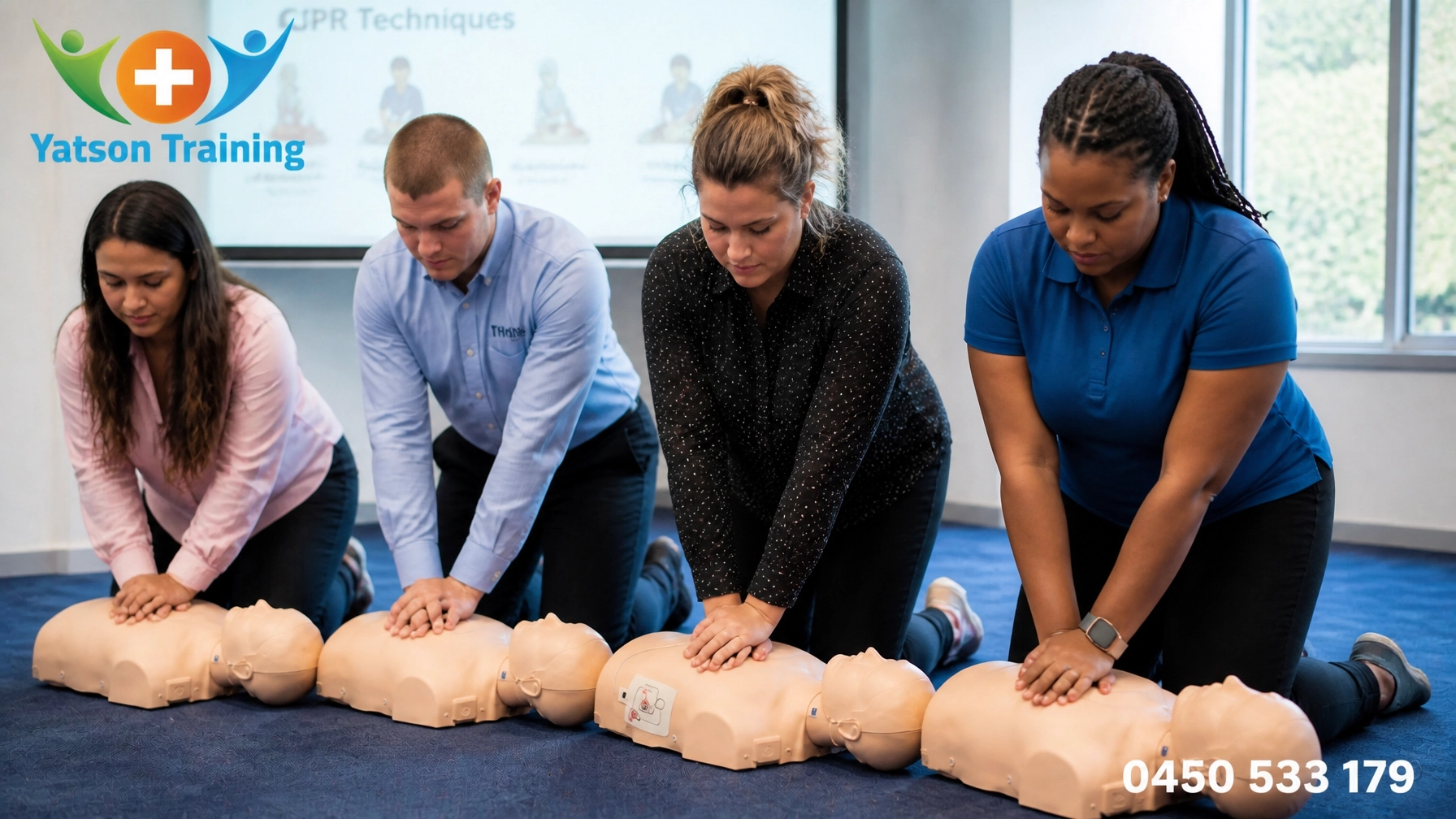
In our Corporate First Aid training sessions, we use high-quality manikins to ensure every participant feels the correct depth and rhythm (about 100–120 beats per minute: think of the beat of "Stayin' Alive").
Minimising Interruptions: The Gold Standard
High-quality CPR is all about maintaining blood flow to the brain. Every time you stop pushing on the chest, the blood pressure drops instantly. The 2026 updates place a "high priority" on minimising interruptions to chest compressions.
- Avoid re-checking: Once you start CPR, do not stop to "see if they are breathing" or check for a pulse unless they show obvious signs of life (like waking up or moving).
- Quick Breaths: If you are providing rescue breaths, they must be delivered quickly (less than 10 seconds for both breaths) so you can get back to compressions immediately.
- Coordinated Swaps: If there are two rescuers, swap roles every two minutes to prevent fatigue, ensuring the swap happens as fast as possible.

Paediatric First Aid: What’s New for 2026?
For educators, childcare workers, and parents, the Childcare First Aid course HLTAID012 is essential. The 2026 updates have made specific changes to how we treat the "little ones."
- No Pulse Checks: Pulse checks are now officially de-emphasised for lay rescuers. They are often unreliable, even for professionals, and cause unnecessary delays.
- Start Promptly: If an infant is unresponsive and not breathing, start compressions immediately.
- Technique Preference: For infants, the "two-thumb encircling" technique (using both thumbs while wrapping your hands around the chest) is the preferred method for healthcare providers and those trained in it, as it provides better blood flow.
At Yatson Training, we specialise in providing these specific skills to Albury and Wodonga childcare centres through our tailored Childcare First Aid training.
Serious Illness: Sepsis and Shock Recognition
First aid isn't just about physical injuries; it's about recognising when someone is getting very sick, very fast. The 2026 guidelines have merged the recognition of "Shock" and "Sepsis" into a more practical framework.
The focus is now on recognising deterioration rather than trying to diagnose the specific medical cause.
- Monitor Vital Signs: Look for pale/clammy skin, rapid breathing, and confusion.
- Act Early: If you suspect a serious illness, call Triple Zero (000) immediately.
- Supportive Care: Keep the patient still, maintain their airway, and provide reassurance while waiting for paramedics.
Why Your Workplace Needs an Update
Compliance isn't just a legal requirement; it’s a moral one. A workplace that is prepared for an emergency is a safer, more productive environment. The 2026 updates mean that older training might still use "outdated" logic that could delay life-saving actions.
By booking Corporate First Aid training for your team, you ensure:
- Legal Compliance: Meeting the latest Safe Work Australia standards.
- Increased Safety: Employees feel confident using an AED (Automated External Defibrillator) and performing CPR.
- Reduced Liability: Showing a commitment to the highest standard of care for your staff and clients.

Keep in Mind: Our Recommendation for 2026
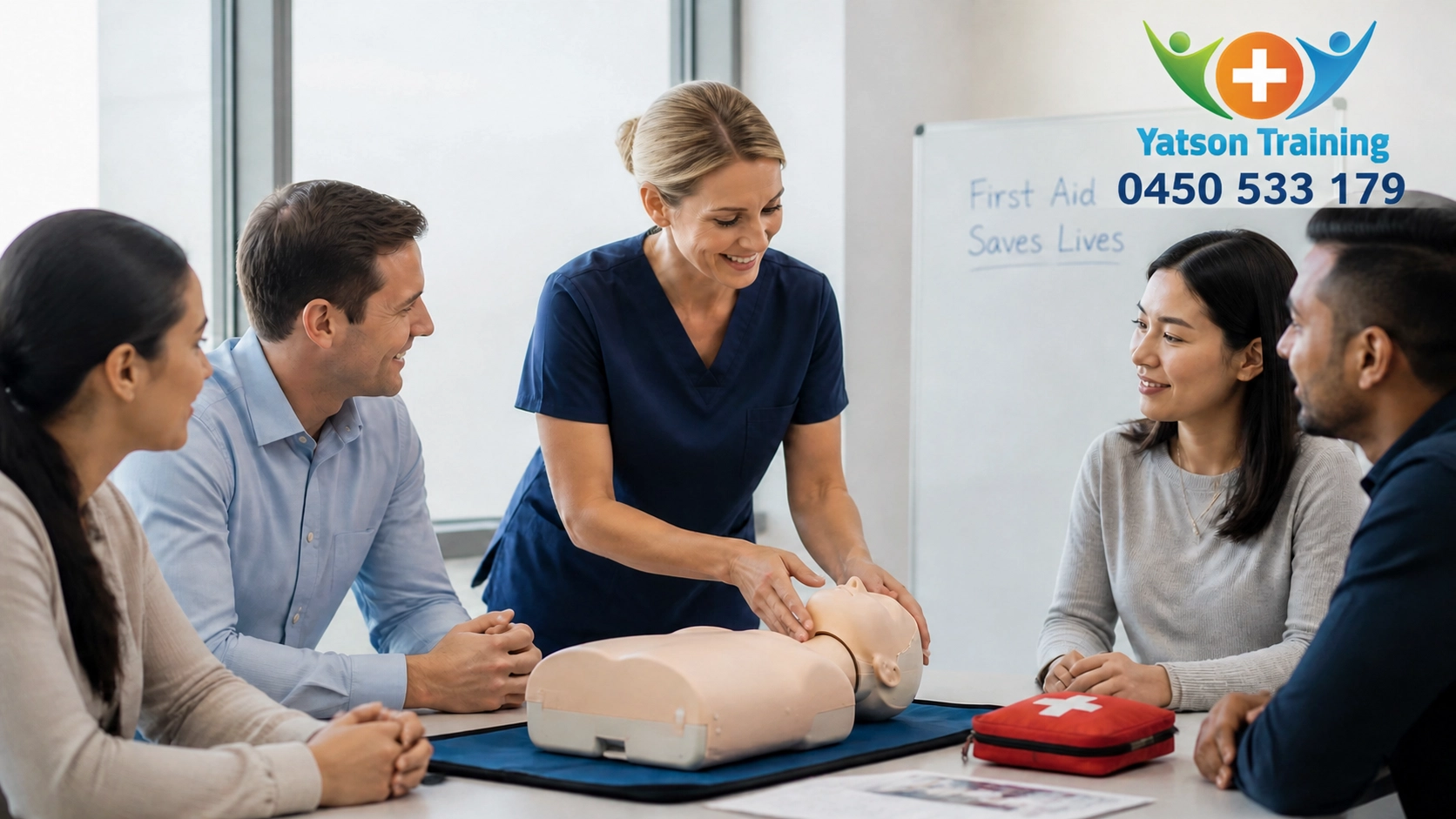
Our lead trainer, Jackie Hislop (RN), always says: "Confidence comes from competence." You can read about these guidelines all day, but nothing replaces the physical sensation of practicing on a manikin or using a trainer AED.
Our recommendation: Do not wait until your certificate expires to refresh your skills. If it has been more than 12 months since your last CPR update, your muscle memory and knowledge of the 2026 standards will likely be rusty. We recommend an annual CPR refresher to keep your Life-saving skills training sharp.
Yatson Training offers flexible, hands-on training for corporate clients, small groups, and individuals across the Albury/Wodonga region. We come to your workplace to make the process as seamless as possible. You can learn more about our team and our approach on our About Us page.
Frequently Asked Questions
Do I need to redo my whole course because of the 2026 updates?
If your current certification is still valid, you are legally compliant. However, if you want to ensure you are following the most effective current medical advice, we recommend attending a short "Update" or "Refresher" session.
How often should my staff practice CPR?
While the formal HLTAID011 Provide First Aid certificate lasts three years, the CPR component should be refreshed every 12 months according to the Australian Resuscitation Council.
Is the training hard to learn?
Not at Yatson Training! We focus on making our sessions interactive, engaging, and (dare we say it?) fun. We strip away the boring "medical-speak" and give you practical tools to handle real-life emergencies.
Can you train our whole team at our office?
Absolutely. We specialise in Corporate First Aid training. We bring all the equipment to you, meaning less downtime for your staff and a training environment they are already comfortable in.
Ready to get your team up to speed with the latest 2026 ANZCOR Guidelines?
Don't leave your workplace safety to chance. Ensure your staff has the confidence to act in an emergency with professional, hands-on training from the experts at Yatson Training.
For all your Workplace First Aid certification needs in Albury, Wodonga, and surrounding areas, call us today.
Telephone: 0450 533 179
Website: yatsontraining.com.au
Follow us for more safety tips:
#FirstAidTraining #AlburyWodonga #WorkplaceSafety #ANZCOR2026 #CPRUpdates #CorporateTraining #LifeSavingSkills #YatsonTraining #HLTAID011 #FirstAidCompliance