What is Australian First Aid and CPR all about?
Australian workplace First Aid and CPR are the immediate actions used to protect a person who is injured or suddenly unwell until paramedics or other advanced medical care arrives.
First Aid may involve controlling bleeding, cooling a burn, supporting a suspected fracture, assisting with asthma or anaphylaxis, or monitoring an unconscious person. CPR is used when a person is unresponsive and not breathing normally. It helps circulate oxygenated blood until an AED or emergency medical team can provide further treatment.
For businesses in Albury and Wodonga, effective workplace safety depends on more than keeping a first aid kit in a cupboard. Your team needs clear procedures, accessible equipment and people with current practical training.
SafeWork guidance recommends that workplaces provide appropriate first aid equipment, facilities and access to trained first aiders. Your arrangements should reflect your workplace size, location, work activities and hazards. Read the SafeWork NSW first aid guidance and review the current ANZCOR resuscitation guidelines for authoritative information.
1. Know your workplace first aid arrangements
Every team member should know what to do before an incident occurs.
During induction and regular safety discussions, show workers:
- Where the first aid kits are located.
- Who the trained first aiders are.
- Where the AED is stored, if one is available.
- How to contact emergency services.
- Which entrance emergency services should use.
- How to report an injury or illness.
- Where emergency exits and evacuation points are located.
Do not assume that workers will find this information when they need it. Display clear signs and include the arrangements in your workplace induction process.
Check whether your procedures work across all operating hours. A workplace may have adequate coverage during the day but no trained first aider on an evening shift, weekend shift or overtime period. Remote workers and mobile workers also require suitable arrangements.
2. Keep first aid kits accessible and maintained
A first aid kit is only useful if workers can reach it quickly and its contents are ready for use.
Place kits in visible, accessible locations. Keep access clear. Do not store them behind stock, inside locked offices or near areas that may become unsafe during an incident.
Nominate a person to inspect each kit regularly. Ask them to:
- Replace used items immediately.
- Check expiry dates.
- Confirm sterile packaging remains sealed.
- Remove damaged or contaminated items.
- Update the contents for current workplace hazards.
- Record inspections and restocking.
Your kit should suit the work being performed. An office may need supplies for minor cuts, sprains and burns. A workshop, warehouse, construction site or commercial kitchen may require additional supplies based on its risk assessment.
Mobile workers should also have suitable first aid supplies in work vehicles. Secure portable kits so they do not become projectiles during a collision.
3. Check your AED and emergency equipment
An automated external defibrillator, or AED, provides step-by-step instructions during a cardiac emergency. It analyses the person’s heart rhythm and advises whether a shock is required.
If your workplace has an AED, make it easy to locate. Check:
- The battery status.
- The expiry date of the electrode pads.
- Whether the unit is visible and accessible.
- Whether workers know how to retrieve it.
- Whether the AED has been included in emergency drills.
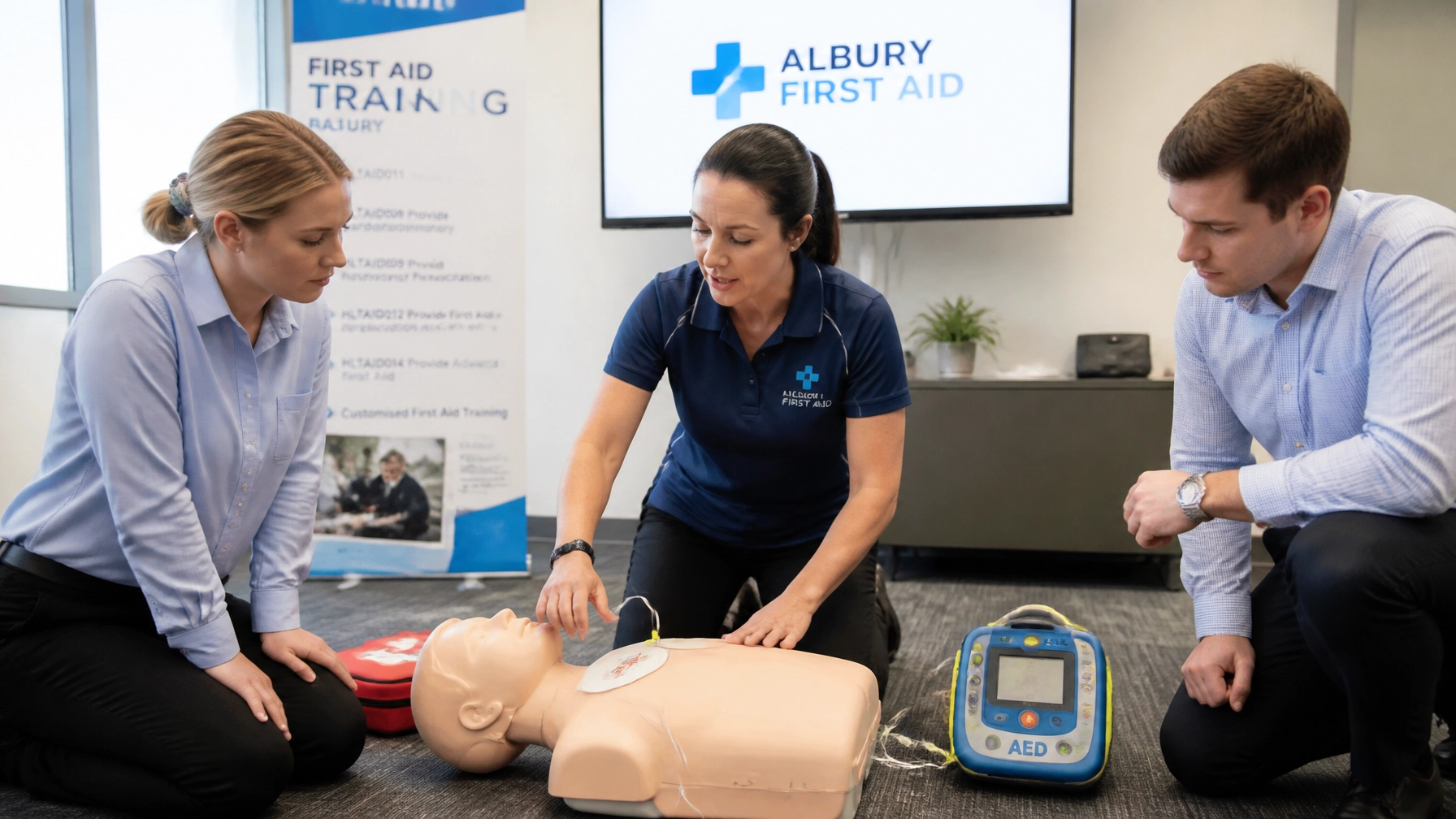
An AED does not replace CPR training. Your team should practise working together: one person calls Triple Zero (000), another starts CPR, and another retrieves the AED.

4. Use DRSABCD during an emergency
DRSABCD provides a structured way to respond. Use it to avoid skipping important safety steps.
- Danger: Check for hazards to yourself, bystanders and the casualty.
- Response: Check whether the person responds to your voice or gentle touch.
- Send for help: Call Triple Zero (000) or direct another person to call.
- Airway: Open the airway and check for obvious obstruction.
- Breathing: Look, listen and feel for normal breathing.
- CPR: Start CPR if the person is unresponsive and not breathing normally.
- Defibrillation: Apply an AED as soon as it arrives and follow its prompts.
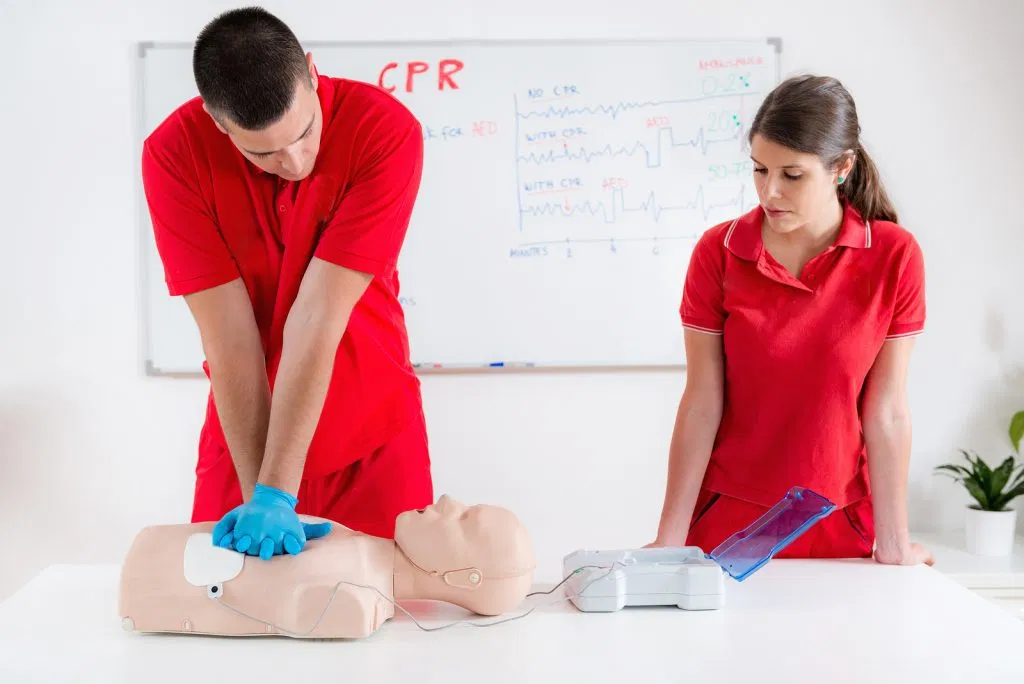
For adult CPR, trained rescuers generally use cycles of 30 compressions and two breaths. Compress at a rate of approximately 100–120 compressions per minute and allow the chest to recoil between compressions. Use the technique taught in your current course, particularly when responding to infants and children.
Do not delay CPR while waiting for a perfect response. Send someone for help and act promptly.
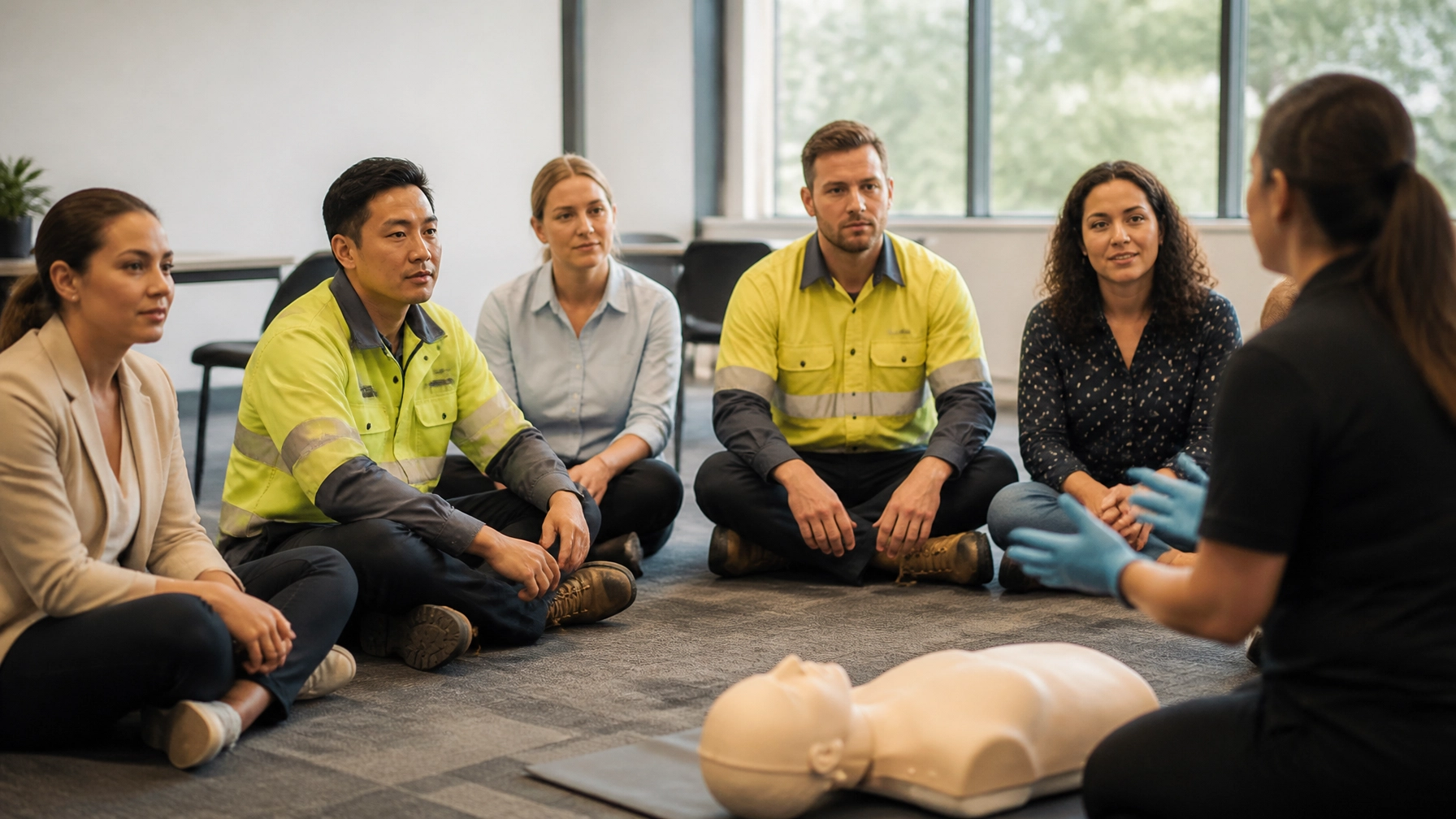
To Learn CPR in Albury / Wodonga, complete practical training with manikins and AED trainers. Hands-on practice helps you understand positioning, compression depth, rescue breaths and team communication.
5. Manage common workplace injuries promptly
Many workplace incidents are minor when treated early but can become more serious when ignored.
Cuts and bleeding
Apply firm, direct pressure with a dressing or clean material. Add another dressing if blood comes through. Do not remove the original dressing. Use gloves and other suitable personal protective equipment to reduce contact with blood and body substances.
Call 000 for severe bleeding, a partial or complete amputation, signs of shock or bleeding that cannot be controlled.
Burns
Remove the source of heat if it is safe to do so. Cool the burn under cool running water for 20 minutes. Remove jewellery or loose clothing near the injury unless it is stuck to the skin. Do not apply ice, creams or adhesive dressings to a serious burn.
Seek medical assistance for extensive, deep or chemical burns, and burns affecting the face, hands, feet, genitals or major joints.
Sprains, strains and fractures
Stop the activity. Support the injured area in a comfortable position. Avoid unnecessary movement, particularly when a spinal injury may be present. Do not attempt to straighten a suspected fracture.
Arrange medical assessment when there is severe pain, deformity, swelling, loss of movement or altered sensation.
Asthma and anaphylaxis
Recognise the person’s symptoms and follow your workplace procedure. Assist with their prescribed medication where appropriate and within the limits of your training. Call 000 for severe breathing difficulty, collapse or suspected anaphylaxis.
6. Choose training that matches your workplace
The right qualification depends on your industry and workplace risks.
- HLTAID009 Provide Cardiopulmonary Resuscitation: Focuses on CPR and AED skills for adults, children and infants. CPR refresher training is generally recommended every 12 months.
- HLTAID011 Provide First Aid: Covers a broad workplace First Aid response, including CPR, bleeding, burns, fractures and common medical emergencies. This is widely used for Workplace First Aid certification.
- HLTAID012 Provide First Aid in an Education and Care Setting: Designed for education and childcare environments. It covers child and infant emergencies, including asthma, anaphylaxis and resuscitation considerations. See the available Childcare First Aid course HLTAID012.
First aid qualifications should be nationally recognised and delivered by an appropriate Registered Training Organisation. Confirm your workplace requirements before booking.
Why choose Yatson Training for your team?
Yatson Training provides flexible, hands-on training for corporate clients, small groups and individuals across Albury, Wodonga and surrounding areas.
Our training is practical and interactive. You practise the physical skills rather than relying only on written information. Lead trainer Jackie Hislop is a Registered Nurse, and the team supports you from the initial enquiry through to training and certification.
Yatson Training can help you arrange:
- On-site Corporate First Aid training.
- Small-group First Aid sessions.
- Individual CPR training.
- HLTAID009, HLTAID011 and HLTAID012 courses.
- Practical guidance for workplace safety and compliance.

Our recommendation: refresh skills before they are needed
Do not wait for an incident to expose gaps in your emergency plan.
Review your first aid arrangements at least annually and after any significant workplace change. Refresh CPR skills every 12 months. Renew general First Aid qualifications according to the applicable training and workplace requirements, commonly every three years.
Run short team discussions about:
- The location of first aid kits and AEDs.
- The correct emergency address.
- The roles people will take during an incident.
- How to manage blood and body substances safely.
- How to report and review incidents.
- How to access debriefing or counselling after a serious event.
The cost of regular training is predictable. The cost of an unprepared response can include preventable harm, lost productivity, regulatory problems and increased business disruption.
Frequently asked questions
Does every Australian workplace need trained first aiders?
Workplaces must provide suitable first aid equipment, facilities and access to trained first aiders or other appropriate arrangements. The number of first aiders depends on workplace risk, workforce size, location, shifts and other factors.
How often should CPR be refreshed?
CPR skills should generally be refreshed annually. Regular practice helps you respond more effectively under pressure.
Is HLTAID011 suitable for workplace compliance?
HLTAID011 Provide First Aid is a nationally recognised qualification commonly used for workplace first aid roles. Confirm the specific requirements for your industry and workplace.
Can Yatson Training train our whole team in Albury or Wodonga?
Yes. Yatson Training offers flexible Corporate First Aid training, small-group sessions and individual courses. Training may be arranged around your workplace and operational needs.
Book professional First Aid training in Albury and Wodonga
Give your team practical skills they can use at work, at home and in the community.
For all your First Aid training needs, telephone Yatson Training today on 0450 533 179. Visit yatsontraining.com.au to explore available courses, or contact us directly to discuss HLTAID009, HLTAID011, HLTAID012 and your workplace requirements.
Follow Yatson Training on Facebook and Instagram.
#FirstAidTraining #AlburyWodonga #WorkplaceSafety #CPRTraining #HLTAID011 #HLTAID009 #HLTAID012 #CorporateFirstAidTraining #WorkplaceFirstAidCertification #LearnCPR #AustralianFirstAid #YatsonTraining