
What is Australian First Aid, CPR and Workplace Safety all about?
Australian First Aid, CPR and workplace safety are about preparing your team to respond quickly and safely when someone is injured or becomes unwell.
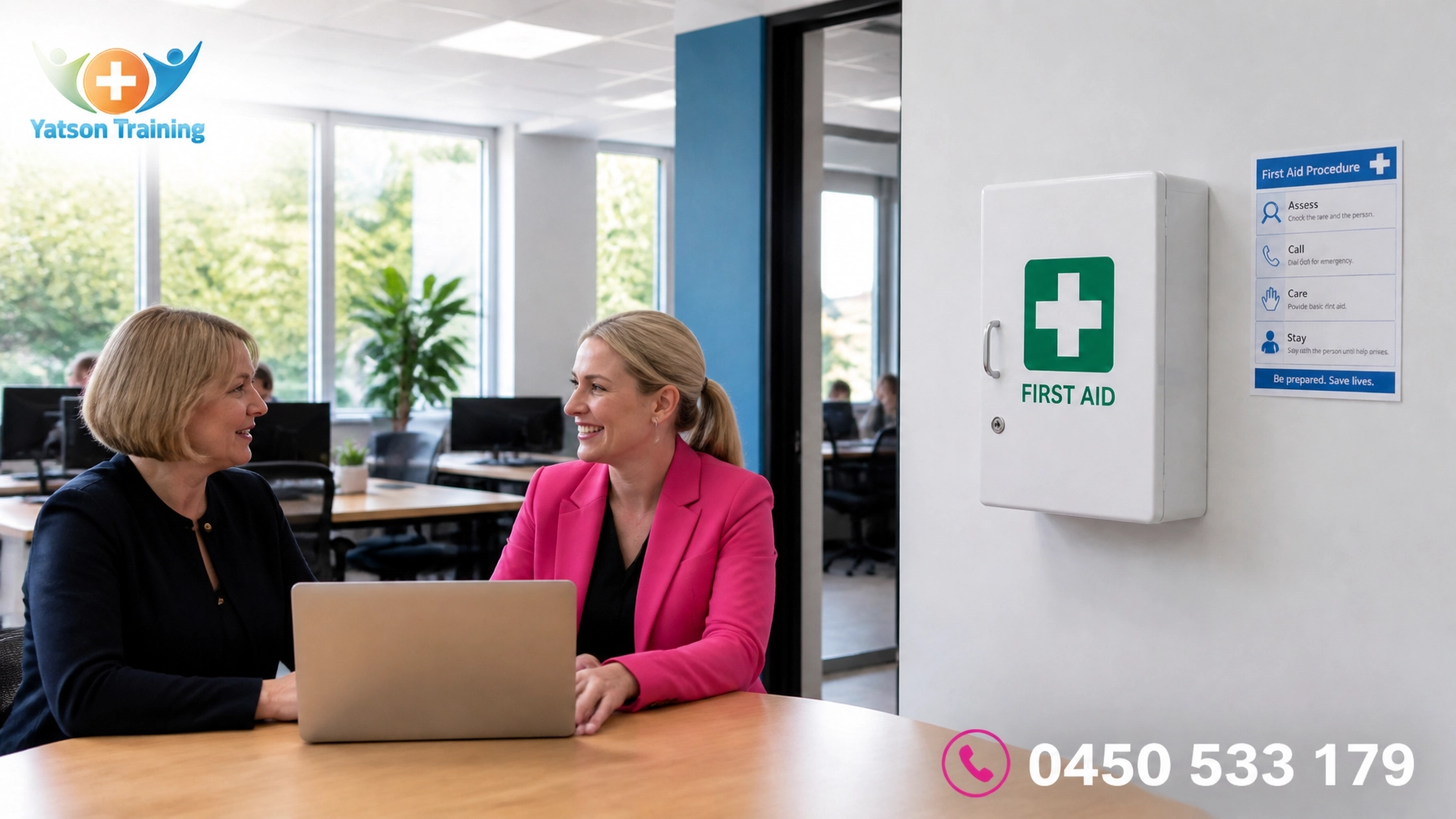
Your workplace emergency plan should explain what to do before professional help arrives. It should cover hazards, trained first aiders, first aid equipment, emergency contacts, evacuation arrangements and incident reporting.
For businesses in Albury and Wodonga, planning is particularly important when teams work across multiple sites, in warehouses, on construction projects, in offices, in hospitality or with children and vulnerable people.
A practical plan does not replace professional medical care. It helps your team take the correct first steps while waiting for Triple Zero (000) assistance.
Start with DRSABCD
Teach your team the Australian DRSABCD action plan. Use it whenever a person is seriously injured, unconscious or not breathing normally.
- Danger: Check the area for hazards. Look for electricity, machinery, traffic, chemicals, fire, unsafe structures or aggressive behaviour.
- Response: Check whether the person responds. Speak loudly and gently squeeze their shoulders.
- Send for help: Call Triple Zero (000), or direct a specific person to make the call. Ask another person to collect the AED (automated external defibrillator), if one is available.
- Airway: Open the mouth and check for an obvious obstruction. Open the airway using a head tilt and chin lift where appropriate.
- Breathing: Look, listen and feel for normal breathing for no more than 10 seconds.
- CPR: Start CPR if the person is unresponsive and not breathing normally.
- Defibrillation: Attach an AED as soon as it is available. Follow the device prompts and keep interruptions to CPR as short as possible.
For adults, trained responders generally perform 30 chest compressions followed by two breaths. Aim for a compression rate of 100 to 120 compressions per minute and a depth of approximately one-third of the chest.
If you cannot provide rescue breaths, compression-only CPR is still preferable to doing nothing. Follow the instructions of the Triple Zero operator and continue until professional help takes over.

Know when to call Triple Zero (000)
Call Triple Zero immediately when a person:
- Is unconscious or not responding.
- Is not breathing normally.
- Has severe bleeding that cannot be controlled.
- Has chest pain, severe difficulty breathing or signs of a stroke.
- Has a serious burn, head injury or spinal injury.
- Has a severe allergic reaction or anaphylaxis.
- Has experienced an electric shock.
- Has had a seizure and does not recover normally.
- Is trapped, exposed to a dangerous substance or at risk of further harm.
Give the call-taker your exact location. Include the street address, business name, building entrance and any access restrictions. Send a staff member to meet the ambulance at the entrance.
Do not delay the call while searching for a first aid kit or waiting for a manager. Early emergency activation can reduce delays in treatment.
For general CPR information, review the healthdirect CPR guidance. In an emergency, always call Triple Zero (000).
Understand the difference between HLTAID011 and HLTAID009
Your training choice should match your workplace risks and compliance needs.
HLTAID011 Provide First Aid
HLTAID011 Provide First Aid covers a broad range of first aid responses. It commonly includes CPR, AED use, bleeding, burns, fractures, choking, asthma, anaphylaxis, shock, seizures and other medical emergencies.
This is the appropriate starting point for many designated workplace first aiders. It supports your broader Workplace First Aid certification requirements and helps staff respond to more than a single type of emergency.
HLTAID009 Provide CPR
HLTAID009 Provide CPR focuses on cardiopulmonary resuscitation and AED use.
CPR skills should generally be refreshed every 12 months. The full first aid qualification is commonly renewed every three years, although your workplace, industry regulator or professional registration requirements may specify additional expectations.
Yatson Training provides both HLTAID011 Provide First Aid and HLTAID009 Provide CPR courses for corporate clients, small groups and individuals.
Build a workplace emergency plan
Write your plan so a staff member can follow it under pressure. Keep the language short and direct.
Include the following information:
-
Identify the site location.
Record the street address, building names, floor numbers and access points. -
List workplace hazards.
Consider machinery, manual handling, chemicals, electricity, working at heights, vehicles, heat, isolated work and public access. -
Nominate trained first aiders.
Record who is available on each shift. Include backup first aiders for leave, breaks and remote work. -
Mark first aid equipment.
Show the location of first aid kits, PPE, emergency eyewash stations and AEDs. -
Assign emergency roles.
Nominate the person who calls 000, collects the AED, meets paramedics, controls bystanders and records the incident. -
Plan for communication.
Ensure staff know how to contact supervisors, emergency services and site managers. -
Document the handover.
Record what happened, what you found, what treatment was provided and when emergency services arrived. -
Review the plan.
Update it after an incident, workplace change, relocation, new equipment or a change in staffing.
Use Safe Work Australia’s first aid guidance as a starting point. Check the requirements that apply to your state or territory, industry and workplace risk profile.

Check your first aid kits and AEDs
A first aid kit is only useful when it is complete, accessible and suitable for your risks.
Assign a person to inspect each kit regularly. Check:
- Gloves and other personal protective equipment.
- Sterile dressings and bandages.
- Wound dressings and pressure bandages.
- Scissors, tape and safety pins.
- Resuscitation equipment.
- Eye protection and eyewash supplies.
- Burn dressings and appropriate burn treatment supplies.
- Expiry dates and damaged packaging.
- Clear signage and unobstructed access.
Consider your work environment. A construction site, commercial kitchen, office, childcare service and warehouse will not require identical supplies.
If you have an AED, check that it is visible, accessible and ready for use. Follow the manufacturer’s maintenance schedule. Inspect pads, batteries, indicator lights and expiry dates.
St John Ambulance Australia provides useful public first aid fact sheets, including information about CPR, burns, choking, AEDs and medical emergencies. These resources support awareness but do not replace accredited First Aid training.
Prevent common workplace injuries
First aid is important, but prevention should remain your first control.
Ask your team to:
- Keep walkways clear.
- Clean spills immediately.
- Secure electrical cords.
- Use suitable PPE.
- Follow manual handling procedures.
- Use mechanical aids for heavy or awkward loads.
- Store chemicals and tools correctly.
- Report damaged equipment.
- Keep emergency exits clear.
- Use safe work procedures around vehicles and machinery.
- Follow check-in procedures when working alone.
- Report bullying, aggression, fatigue and other psychosocial hazards.
Review near misses as well as actual injuries. A near miss can show where your controls are weak before someone is harmed.
Run short emergency drills during toolbox talks or team meetings. Practise calling 000, locating the first aid kit, retrieving the AED and guiding paramedics to the casualty.
Choose hands-on training for your team
Reading a procedure is not the same as practising a response.
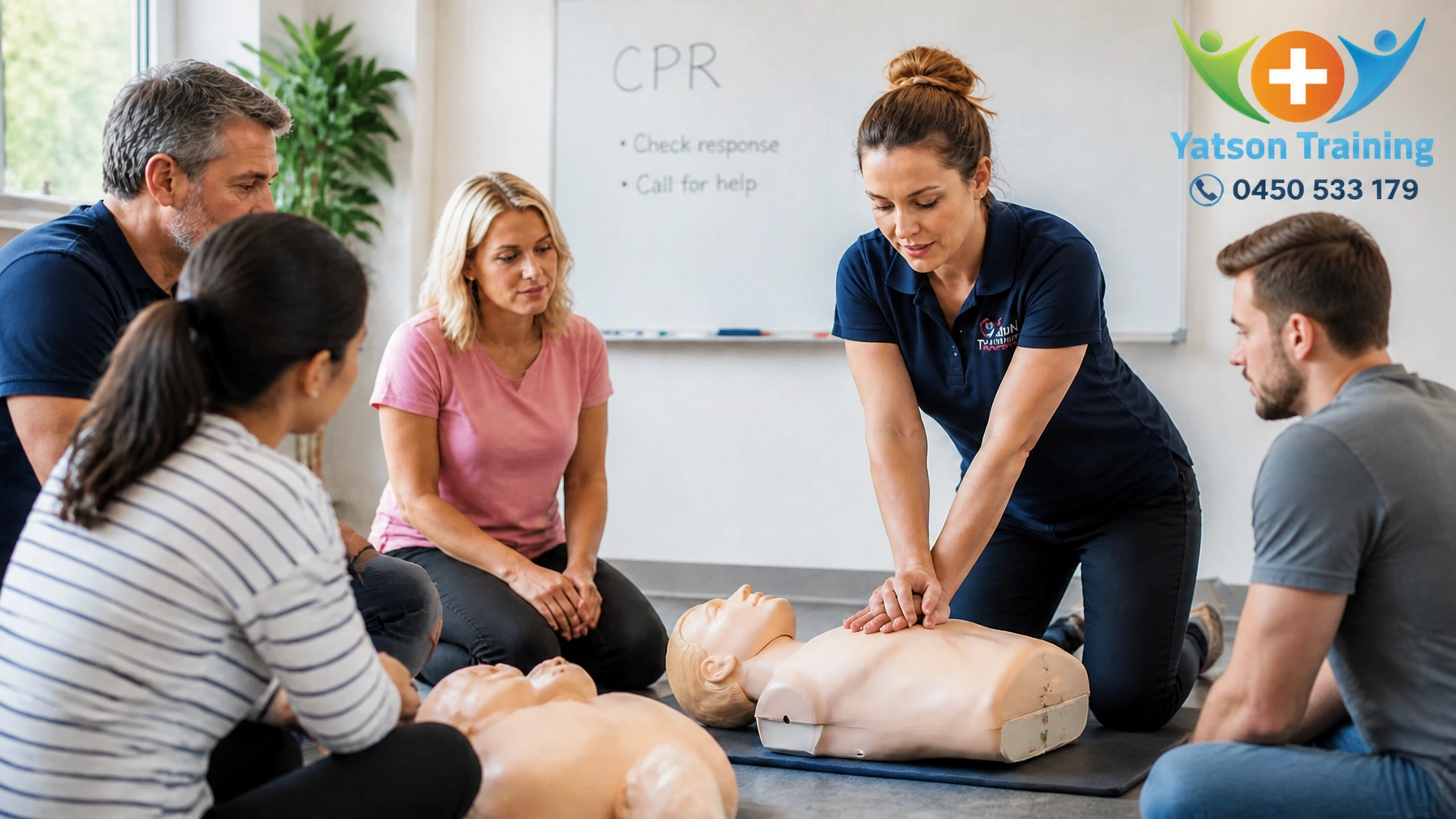
Hands-on training allows your staff to rehearse chest compressions, rescue breaths, AED use, recovery position, bleeding control, bandaging and other practical skills. It also gives your team the opportunity to ask questions about realistic workplace scenarios.
Yatson Training delivers professional Corporate First Aid training in the Albury-Wodonga area. Training can be arranged for corporate workplaces, small groups and individuals.
Lead trainer Jackie Hislop is a Registered Nurse with experience in the medical field and aged care. Yatson Training focuses on interactive instruction, experienced trainers and support from the initial enquiry through to final certification.
If your team works in education or care, Yatson Training also provides HLTAID012 Provide First Aid in an Education and Care Setting.

Our recommendation
Do not wait until a certificate is about to expire.
Create a training and equipment register that records:
- Staff member and role.
- Course completed.
- Certificate date.
- CPR refresher due date.
- Full first aid renewal date.
- Worksite or shift covered.
- First aid kit inspection dates.
- AED maintenance checks.
- Emergency drill dates.
Book refresher training early. Maintain enough trained staff to cover annual leave, sick leave, different shifts and multiple locations.
For reliable First Aid Training Albury Wodonga businesses can use, contact Yatson Training to discuss your workplace risks and group requirements.
Frequently asked questions
Is workplace first aid training necessary?
Most workplaces need suitable first aid arrangements, including appropriate equipment, facilities and trained people. The exact arrangements depend on your work environment, hazards, size and location. Use Safe Work Australia guidance and check the requirements applying to your workplace.
How often should CPR be refreshed?
CPR skills should generally be refreshed every 12 months. Confirm the requirements for your industry and role before booking.
Can small businesses book group training?
Yes. Yatson Training offers flexible, hands-on training for corporate clients, small groups and individuals. Training can be discussed around your team size, location and operational needs.
Where can I Learn CPR in Albury Wodonga?
Yatson Training provides HLTAID009 Provide CPR training for local workplaces, groups and individuals.
Book your First Aid training
Give your team practical skills they can use when time matters. Telephone Yatson Training on 0450 533 179 for all your First Aid training needs, including HLTAID011 Provide First Aid, HLTAID009 Provide CPR, Corporate First Aid training and Workplace First Aid certification.
Visit yatsontraining.com.au to review available courses and enquire about training in Albury, Wodonga and surrounding areas.
Follow Yatson Training for course updates and workplace safety information on Facebook, Instagram, YouTube and the Yatson Training social media news page.
#FirstAidTraining #AlburyWodonga #WorkplaceSafety #CPRTraining #HLTAID011 #HLTAID009 #CorporateFirstAid #WorkplaceFirstAid #FirstAidTrainingAlburyWodonga #LearnCPR #AustralianFirstAid