What is first aid for workplace eye injuries all about?
Workplace eye first aid is the immediate care provided after an eye injury, chemical splash, foreign object or UV exposure. Its purpose is to limit further damage while you arrange professional medical treatment.
Eye injuries can happen quickly in Albury Wodonga workplaces. Manufacturing, agriculture, welding, construction, transport, automotive, maintenance and general trades all involve hazards that can affect vision.
Common hazards include:
- Flying metal, dust, wood or masonry particles.
- Chemical liquids, powders, concrete, solvents and cleaning products.
- Welding arcs and other sources of intense ultraviolet light.
- Pressurised hoses, compressed air and machinery.
- Straps, tools or materials that can strike the face.
- Poorly maintained or incorrectly fitted eye protection.
A minor-looking injury can still damage the cornea (the clear surface at the front of the eye). Treat every eye injury carefully. If vision is affected, the injury is severe or the chemical is corrosive or unknown, call Triple Zero (000).
This article provides general workplace first aid information. It does not replace medical assessment or professional First Aid training.
Chemical splashes: act immediately
Chemical eye injuries are time-critical. Alkalis and corrosive substances can continue damaging the eye even when pain initially seems mild.
If a chemical splashes into the eye, follow these steps:
- Stop the exposure. Move away from the chemical source and alert nearby workers.
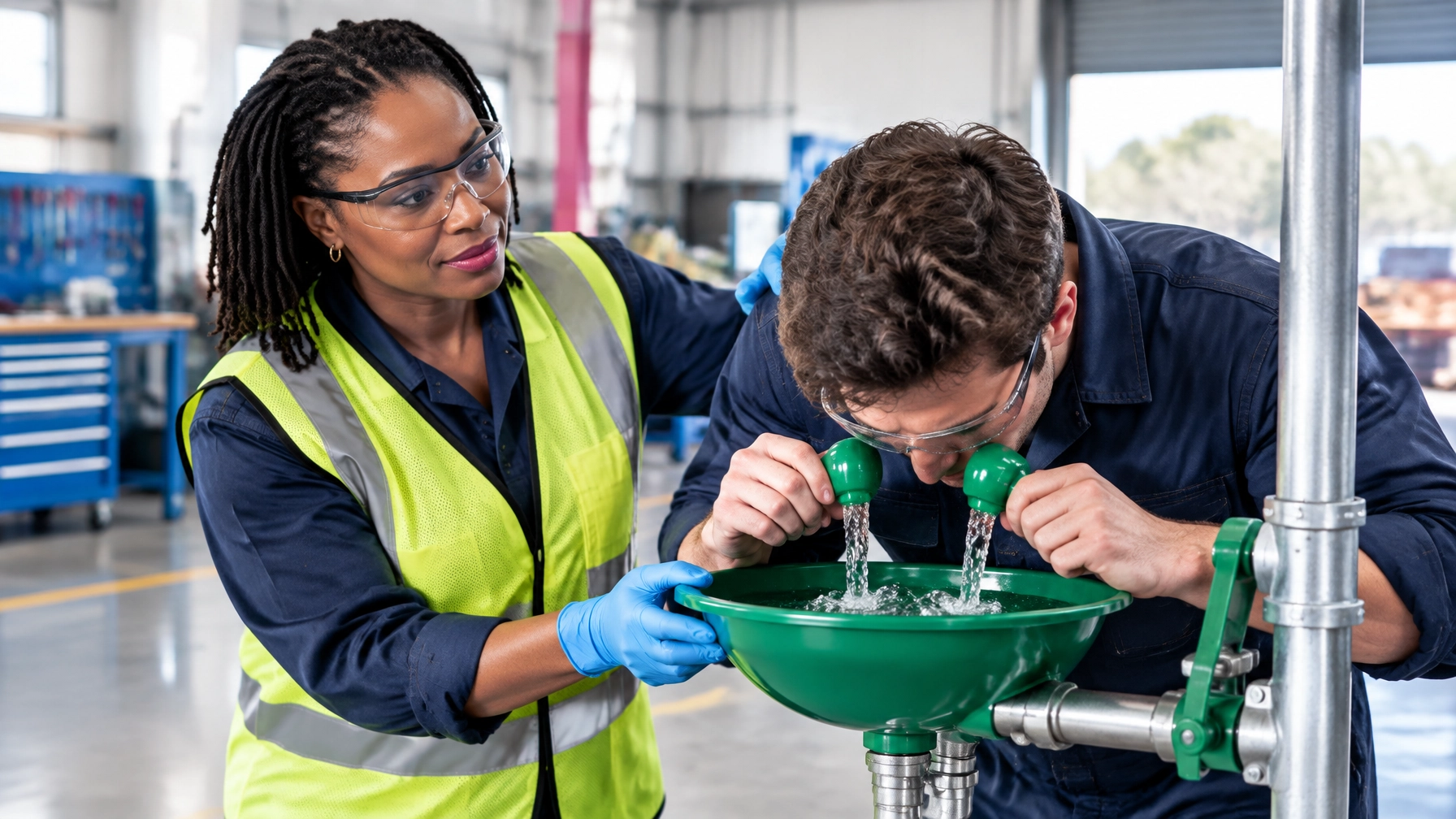
- Go straight to clean running water. Use an emergency eyewash station, safety shower, tap or another reliable source of clean water. Do not delay while looking for a small bottle of saline.
- Hold the eyelids open. Use clean fingers, provided they are free from the chemical.
- Tilt the head. Position the affected eye lower than the other eye so contaminated water flows away from the unaffected eye.
- Flush continuously. Irrigate the eye for at least 15 to 20 minutes. Continue for longer when directed by the product safety data sheet or emergency services.
- Remove contact lenses if easy. Start irrigation immediately. Do not stop flushing to remove contact lenses.
- Call Triple Zero (000) for serious exposures. Treat corrosive, alkaline, powder or unknown chemicals as urgent emergencies.
- Take the safety data sheet (SDS) details with you. Tell paramedics and medical staff the chemical name, concentration, form, time of exposure and approximate irrigation time.
Do not rub the eye. Do not attempt to neutralise the chemical with another substance. Do not apply creams, drops or other products unless directed by a medical professional.

How to irrigate an eye safely
Correct technique matters. Workers may instinctively clamp their eyelids shut because of pain or fear. A trained first aider can provide calm, practical assistance.
Use this method:
- Position the casualty beside the eyewash station or under a gentle flow of clean water.
- Keep the affected eye open as much as possible.
- Direct water across the eye from the nose side towards the outside of the face where practical.
- Avoid allowing contaminated water to run into the unaffected eye.
- Encourage the casualty to look in different directions while flushing, if they can do so comfortably.
- Continue irrigation while waiting for medical assistance.
- Keep the casualty seated and prevent them from rubbing the eye.
If there is a dry powder on the face, brush away loose material carefully before irrigation where this can be done without spreading it. Then flush thoroughly. Do not delay irrigation for a lengthy cleaning process.
Better Health Victoria advises that acids and alkalis can cause serious damage, including vision loss. Pain is not a reliable measure of severity. Some dangerous chemicals may cause limited pain at first.
Foreign objects, cuts and embedded materials
Loose dust or small particles may often be flushed with clean water. Tell the casualty not to rub the eye.
Do not try to remove an object that is embedded, stuck or penetrating the eye. This includes metal fragments, glass, wire, tools or other sharp materials.
Instead:
- Keep the casualty still and calm.
- Do not press on the injured eye.
- Do not wash or flush a suspected penetrating injury.
- Place a loose eye shield or clean protective covering over the eye without applying pressure.
- If possible, cover both eyes to reduce eye movement.
- Call Triple Zero (000).
- Monitor the casualty and follow the instructions of emergency services.
Seek urgent medical care for persistent pain, redness, light sensitivity, blurred vision, bleeding, swelling or the sensation that something remains in the eye.
Welding flash and UV burns
Welding flash, also called arc eye or photokeratitis, is caused by exposure to intense ultraviolet light. Symptoms may not appear immediately. They can develop several hours after welding or exposure.
Symptoms may include:
- Gritty or sandy feeling in the eyes.
- Watery eyes.
- Redness.
- Light sensitivity.
- Burning discomfort.
- Difficulty keeping the eyes open.
- Blurred vision.
Move the worker away from the welding arc or UV source. Prevent further exposure. Tell them not to rub their eyes and place them in a dim environment while arranging same-day medical assessment.
A cool compress over closed eyelids may provide limited comfort. Do not use someone else’s eye drops or attempt to treat the injury with medication.
Call Triple Zero (000) if there is severe or increasing pain, vision loss, a suspected metal fragment, penetrating injury, significant head trauma or loss of consciousness.
When should your workplace call Triple Zero (000)?
Call Triple Zero (000) immediately when:
- A corrosive, alkaline, powder or unknown chemical enters the eye.
- Vision is lost, blurred or significantly changed.
- An object is embedded in or has penetrated the eye.
- There is bleeding from the eye or suspected damage to the eyeball.
- Severe pain follows an impact, chemical splash or welding exposure.
- The casualty has a serious facial or head injury.
- The casualty is unconscious, confused or deteriorating.
- The workplace cannot safely transport the casualty for urgent care.
Continue chemical irrigation while waiting for the ambulance. Ask another worker to collect the product container or SDS. Keep the casualty away from further exposure.
For Victorian workplaces, review guidance from WorkSafe Victoria and Better Health Victoria. For suspected poisoning or chemical exposure advice in Victoria, contact the Victorian Poisons Information Centre.
Prevent eye injuries in Albury Wodonga workplaces
Prevention should be part of normal Workplace Safety planning. It is particularly important for businesses operating workshops, farms, factories, depots, building sites and transport facilities across Albury and Wodonga.
Use a risk assessment to:
- Identify tasks involving dust, particles, chemicals, pressure or UV light.
- Check the chemical label and current SDS.
- Select safety glasses, sealed goggles or a face shield for the task.
- Use welding helmets and filters that are suitable for the work.
- Make sure PPE fits correctly and is maintained.
- Provide protection for nearby workers and visitors, not only the person operating machinery.
- Keep emergency eyewash stations easy to reach and clearly identified.
- Check that eyewash equipment is clean, maintained and capable of providing continuous flushing.
- Train workers to use the eyewash station before an incident occurs.
- Keep first aid kits accessible and stocked with appropriate eye injury supplies.
- Review procedures after an incident, near miss or change in work process.
Ordinary prescription glasses and sunglasses are not a substitute for workplace eye protection. Contact lenses also do not protect the eye and may worsen chemical exposure. Follow the manufacturer’s instructions and applicable Australian Standards when selecting PPE.

Why professional First Aid training matters
A written procedure is useful, but workers also need the confidence to act correctly. Professional training helps your team recognise serious eye injuries, use PPE, respond to chemical splashes and communicate with emergency services.
Yatson Training provides flexible, hands-on Corporate First Aid training for Albury Wodonga businesses, small groups and individuals. Our experienced trainers, including lead trainer Jackie Hislop, a Registered Nurse, focus on practical skills rather than a dry compliance exercise.
The nationally recognised HLTAID011 Provide First Aid course covers common workplace emergencies, including CPR, serious injuries and first aid response until medical assistance arrives. Yatson Training can also help workplaces arrange HLTAID009 Provide CPR and the Childcare First Aid course HLTAID012 for education and care settings.
Training is one part of your Workplace First Aid certification arrangements. You must also consider your site hazards, number of workers, shifts, access to emergency services, first aid equipment and local procedures.
Our recommendation
Do not wait for an eye injury before checking your response plan.
Walk through your workplace and confirm that every worker knows:
- Where the eyewash station is located.
- How to start irrigation immediately.
- Who the trained first aiders are.
- When to call Triple Zero (000).
- Where chemical SDS information is stored.
- Which PPE is required for each task.
- How to report an incident and arrange medical follow-up.
For manufacturing, agriculture, trades and transport businesses in Albury Wodonga, combine suitable PPE and emergency equipment with regular, practical First Aid training.
Frequently asked questions
Is workplace eye injury training necessary if we already have an eyewash station?
Yes. An eyewash station only helps if workers can reach it quickly and know how to use it. Practical First Aid training reinforces immediate irrigation, safe positioning and emergency escalation.
Is HLTAID011 Provide First Aid enough for every workplace?
HLTAID011 is a nationally recognised foundation for workplace first aid, but your business may need additional equipment, procedures or training based on its hazards. Review your arrangements against your workplace risk assessment and relevant guidance from Safe Work Australia.
What is the most cost-effective way to improve workplace safety?
Start with prevention. Provide suitable PPE, maintain eyewash stations, keep SDS information accessible and train workers before an incident occurs. Contact Yatson Training for practical advice and flexible group options.
Book First Aid training in Albury Wodonga
Protect your workers with professional, hands-on training tailored to your workplace. Telephone Yatson Training on 0450 533 179 for Corporate First Aid training, small group training or individual course options.
Visit yatsontraining.com.au or contact Yatson Training to discuss your requirements.
You can also connect through the social channels listed on the Yatson Training website: Facebook, LinkedIn, YouTube and Twitter.
#FirstAidTraining #FirstAidTrainingAlburyWodonga #HLTAID011 #CorporateFirstAidTraining #WorkplaceFirstAidCertification #WorkplaceSafety #EyeInjuryFirstAid #ChemicalSafety #CPRTraining #AlburyWodonga #WodongaBusinesses #AlburyBusinesses